Cat Coat Color Genetics Calculator — Kitten Predictor
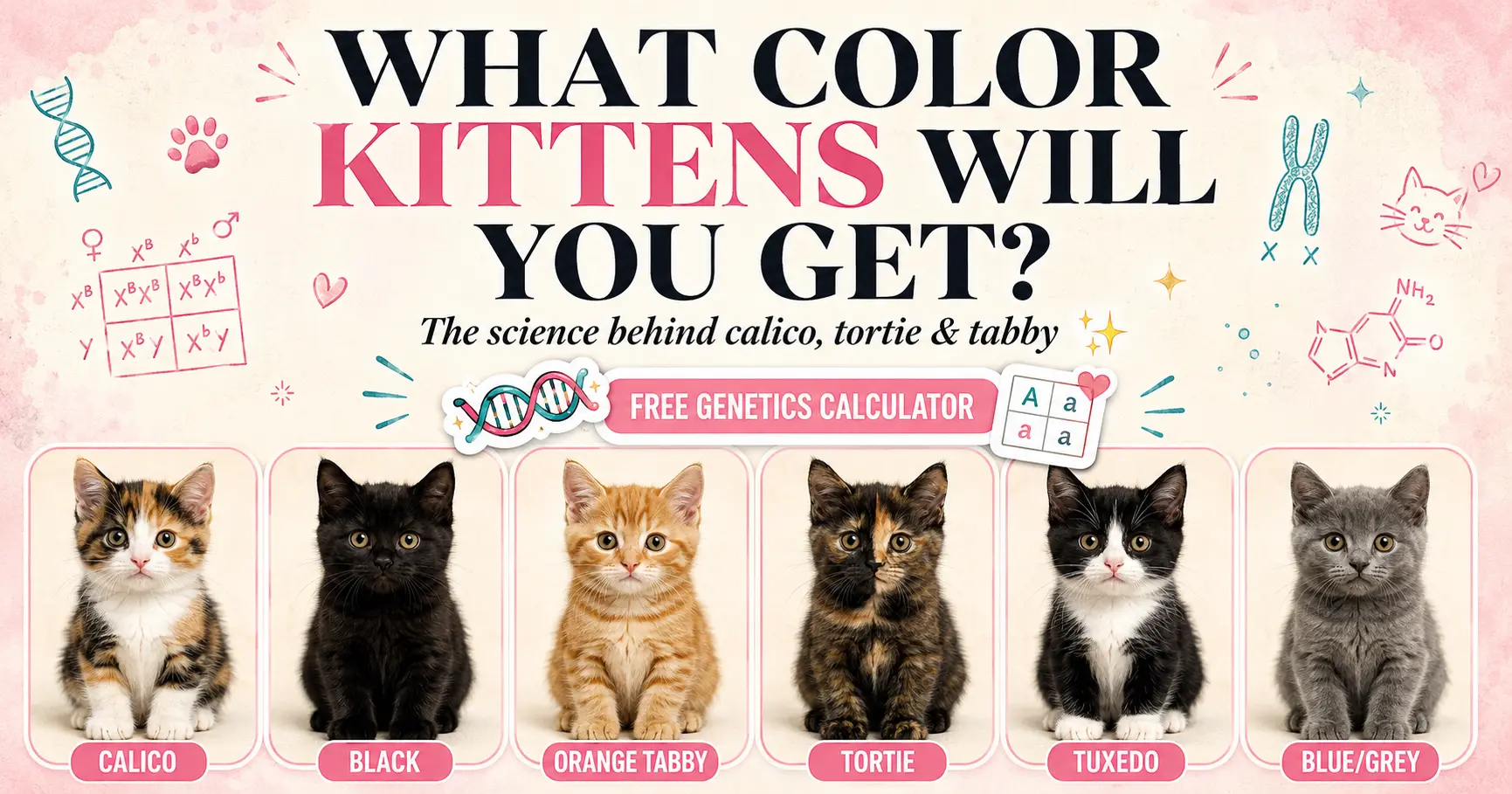
Cat coat genetics is one of the more elegant examples of Mendelian inheritance you can spot in a household pet. Six or seven genes, two of them sex-linked, combine to produce every coat pattern from jet black to dilute calico. This calculator runs the Punnett squares for you — pick the parents' colors and see the probability of each outcome split by male and female kittens.
Cat Coat Color Genetics Calculator
Pick the parents' coat colors. The calculator runs the Punnett squares and shows the kitten outcome probabilities.
Male cats cannot normally be calico or tortoiseshell (X-linked inheritance).
Toggle these if you know the parents carry these recessive alleles even though they don't show them.
How the calculation works
How to Use the Cat Coat Color Calculator
The whole prediction runs in under a minute. The genetics happen behind the scenes.
- 1
Pick the mother's coat color
Choose the queen's visible color. The calculator infers her likely genotype across the orange, dilution, and agouti loci. For mixed colors like tortoiseshell, the genotype is unambiguous because of X-linked inheritance.
- 2
Pick the father's coat color
Choose the tom's color. Note that male cats cannot be calico or tortoiseshell unless they have the rare XXY karyotype, so those options aren't available for the father.
- 3
Optionally toggle dilution and white spotting
If you happen to know the parents carry the dilute gene or white spotting, switch on the toggles to narrow the predictions. Without these toggles, the calculator assumes standard genotypes.
- 4
Read the predicted outcomes
Results show the probability of each kitten color, split by male and female because X-linked traits affect the sexes differently. A bar chart visualises the distribution.
The Six Genes Behind Every Cat's Coat
Domestic cat coat genetics revolves around a small cast of genes, each acting at a specific step in pigment production or distribution. Knowing the cast helps make sense of every pattern you see at a shelter or cat show.
Orange (O) — X-linked
Located on the X chromosome. The dominant O allele produces pheomelanin (orange/red pigment). The recessive o allele produces eumelanin (black). Females (XX) can be heterozygous, expressing both as the patchwork tortoiseshell or calico. Males (XY) carry only one copy and appear either fully orange or fully non-orange.
Dilution (D) — autosomal at MLPH locus
Controls pigment density. The dominant D allele produces dense color. The recessive d allele dilutes black to blue-grey, chocolate to lilac, and orange to cream. Cats must be dd (homozygous recessive) to appear dilute.
Agouti (A) — autosomal at ASIP locus
Determines whether tabby pattern is visible. Dominant A reveals stripes. Recessive a/a hides them, producing solid coats. Orange cats always show tabby markings regardless of Agouti status because pheomelanin doesn't form solid bands.
Tabby pattern (Mc / Ta) — autosomal
Within agouti-positive cats, three patterns exist: Mackerel (Mc) creates narrow vertical stripes, classic (mc/mc) creates broad swirls, and Ticked (Ta) eliminates body stripes leaving only head and leg markings (typical of Abyssinians).
White Spotting (S) — autosomal
Incompletely dominant. Heterozygous Ss cats show low-to-medium white (locket, mittens, bicolor). Homozygous SS cats often have 50%+ white. The S allele on a tortoiseshell creates the classic calico pattern.
Dominant White (W) — autosomal at KIT locus
The most powerful color gene of all. A single dominant W allele masks every other color gene, producing a solid white cat regardless of the other genotype. The same gene is linked to congenital deafness — roughly 65-85% of white cats with two blue eyes are deaf in one or both ears.
A handful of breed-specific modifiers exist beyond this core set — the colorpoint allele in Siamese, the sepia allele in Burmese, and the Lykoi "werewolf" gene among others. For breed-specific patterns, see our guides on cat coat patterns by breed and rare cat breeds.
Why Almost All Calicos Are Female
The Orange gene sits on the X chromosome — one of only a handful of X-linked color genes in mammals. This single fact explains the near-exclusive female calico phenomenon.
Female cats are XX. They can carry the O (orange) allele on one X chromosome and the o (non-orange) allele on the other. During embryonic development, a process called X-inactivation — discovered by British geneticist Mary Lyon in 1961 and sometimes called lyonisation — randomly silences one X chromosome in each cell. The cell's descendants all inherit the same silencing pattern. The result: visible patches of cells expressing either orange or non-orange pigment.
Male cats are XY. They carry one Orange allele on their single X chromosome. They're either entirely orange or entirely non-orange — no mixing possible.
The rare male calico is almost always XXY (Klinefelter syndrome), which gives him two X chromosomes and allows the patchwork to appear. Klinefelter cats occur roughly once in every 3,000 male births and are almost universally sterile. Other rare paths to a male calico include chimerism (two fertilised eggs fusing) and somatic mutation — both extraordinarily uncommon.
Coat Color Frequency in Random-Bred Cats
Approximate frequencies for random-bred (non-pedigree) cats, drawn from population studies in the UK and US.
| Coat color | Approximate frequency | Genotype shorthand |
|---|---|---|
| Brown tabby | ~30% | A/- D/- T/- |
| Black solid | ~15% | a/a D/- |
| Black-and-white (tuxedo) | ~10% | a/a D/- S/- |
| Orange tabby | ~10% (more males) | X^O/Y or X^O X^O |
| Tortoiseshell | ~7% (♀ only) | X^O X^o |
| Calico | ~6% (♀ only) | X^O X^o S/- |
| Blue (grey) | ~5% | a/a d/d |
| White solid | ~4% | W/- (any other) |
| Dilute calico | ~2% (♀ only) | X^O X^o d/d S/- |
| Pure cream / chocolate | <1% each | X^O/Y d/d or b/b |
See our breakdown of cat coat patterns by breed for how purebred populations differ from these random-bred figures.
How Accurate Are These Predictions?
The calculator uses standard Mendelian Punnett-square mathematics on the most commonly known cat color genes. It predicts probabilities accurately when the inputs match the cats' true genotypes. Several caveats apply:
- Phenotype (what you see) does not always reveal genotype (what's in the genes). A "solid black" cat may carry a hidden orange allele, a hidden dilute allele, or both.
- White spotting expression varies widely. The calculator handles broad categories but cannot predict exact patch placement.
- Tabby patterns (mackerel vs. classic vs. ticked) are not predicted in detail — the calculator focuses on the primary color genes.
- Breed-specific genes (colorpoint, sepia, fawn, etc.) are not modelled in this version.
- Genetic testing through services like Optimal Selection or Basepaws gives true genotypes and overrides phenotypic guesswork. For more on that, see our guide to cat DNA testing.