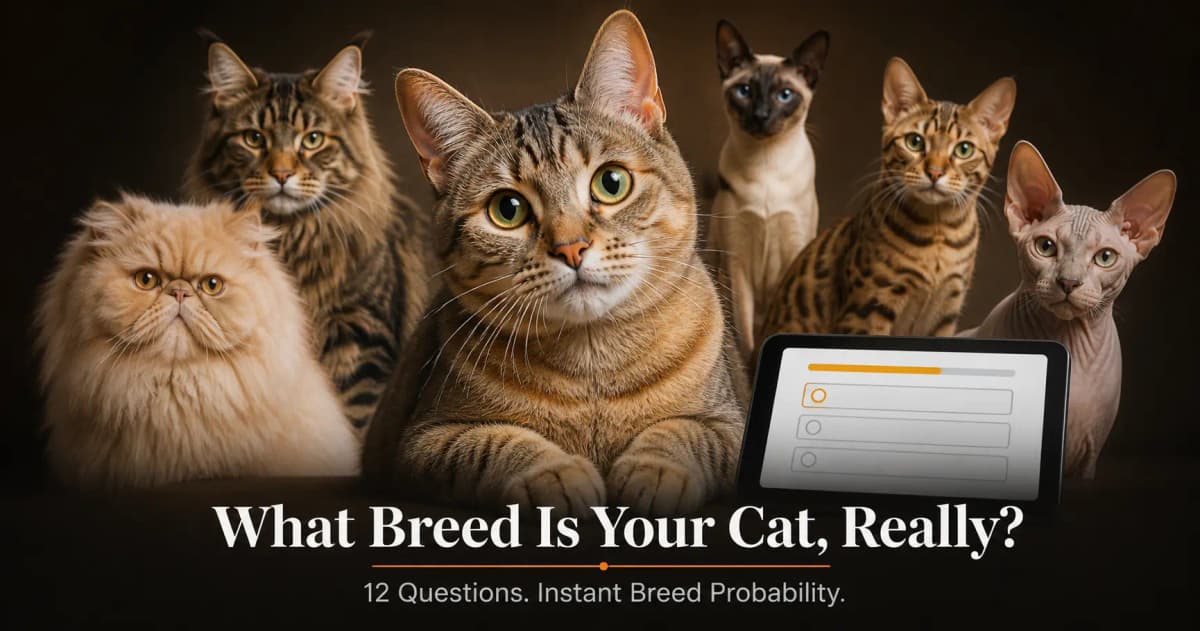
Coat pattern is one of the most genetically informative visible traits in domestic cats. Understanding the pattern on your cat's coat can immediately narrow down their likely breed ancestry — because certain patterns are controlled by specific genes that are far more common in some breed lineages than others.
The genetics of coat colour and pattern in domestic cats are well-documented in the scientific literature. The cat coat genetics article on Wikipedia provides a solid overview of how the agouti gene, tabby modifier genes, and sex-linked colour genes interact to produce the patterns described below.
Tabby (Mackerel and Classic)
Gene: Agouti gene + Tabby modifier
The most common pattern in domestic cats. Mackerel tabby shows narrow parallel stripes. Classic (blotched) tabby shows swirled marbled patterns. Both are controlled by the tabby modifier gene acting on the agouti locus. Common in Maine Coon, Domestic Shorthair, and most non-specialist breeds.
Most common in: Maine Coon, Domestic Shorthair, Norwegian Forest Cat
Spotted tabby
Gene: Tabby modifier + spot gene
Oval or round spots instead of stripes — caused by modifier genes breaking up the tabby striping into discrete spots. Rosette patterns (two-toned spots) are a Bengal-specific expression of this gene combination, enhanced by selective breeding from Asian Leopard Cat introgression.
Most common in: Bengal (rosette spots), Abyssinian (ticked variant), Ocicat
Ticked agouti
Gene: Agouti gene (homozygous Ta allele)
Each individual hair carries 4–6 alternating dark and light colour bands — producing a luminous, uniform coat with no visible stripe or spot markings on the body. This pattern is most strongly associated with the Abyssinian breed, where it has been selectively fixed.
Most common in: Abyssinian, Somali
Colourpoint
Gene: Temperature-sensitive tyrosinase (cs allele)
Pigmentation is restricted to cooler body extremities (face mask, ears, paws, tail) — called 'points'. The warm body core remains pale. Caused by a heat-sensitive enzyme variant that inhibits melanin production above a threshold body temperature.
Most common in: Siamese, Ragdoll, Balinese, Himalayan
Solid / Self
Gene: Non-agouti (aa) homozygous
A single uniform colour with no pattern markings. Requires homozygous non-agouti gene expression to suppress tabby pattern visibility. The Russian Blue, Burmese, and Bombay are classic solid/self coat examples.
Most common in: Russian Blue, Burmese, British Shorthair (blue), Bombay
Tortoiseshell / Calico / Van
Gene: X-chromosome linked orange gene
Tortoiseshell (black + orange patches) and calico (tri-colour with white) are almost exclusively female — caused by random X-chromosome inactivation in cells. Van pattern describes a predominantly white cat with colour restricted to head and tail only.
Most common in: Domestic Shorthair (tortie, calico), Turkish Van (Van pattern)