Your cat's coat is not an accident. Every stripe, spot, swirl, and color patch is the result of specific genes — genes that were shaped by centuries of natural variation and, in some breeds, deliberate selective breeding. Once you understand what those patterns mean, your cat's coat becomes one of the most readable clues you have about its ancestry.
This guide covers every major coat pattern and color found in domestic cats (Felis catus), explains the genetics behind each one in plain English, and maps them to the breeds most commonly associated with them. Whether your cat is a mystery rescue or a suspected purebred, understanding its coat is the fastest way to start narrowing down the answer. If you already know the pattern but want to go further, our full physical identification guide covers body type, face shape, eye color, and ears alongside coat — giving you a more complete picture.
Why Coat Pattern Matters for Breed Identification
Most people start with coat color when trying to identify a cat. That's understandable — color is the first thing you notice. But color alone is the least diagnostically useful feature. An orange cat can be a Persian, a Maine Coon, an Abyssinian, or a random domestic shorthair. Color without pattern context tells you almost nothing.
Pattern is the more powerful signal. A rosette-spotted coat does not appear randomly in the general cat population — it requires specific genetics linked to Bengal breeding lines. A ticked coat with no stripes or spots points almost directly to Abyssinian heritage. A pointed coat with blue eyes is genetically connected to the Siamese family in a way that very few other traits are. Learning to read patterns the way registries do gives you a significant head start in understanding your own cat.
The Genetics Foundation: How Coat Patterns Are Inherited
Before diving into individual patterns, a brief genetics foundation helps everything make more sense.
Cat coat patterns are controlled by a series of genes operating at different levels. The most important concept is that these genes interact in a hierarchy — some genes switch others on or off, and the final visible coat is the result of multiple genes expressing simultaneously.
The key genes to know:
- The Agouti gene (A) — controls whether tabby banding appears on individual hairs. Dominant form (A) produces tabby pattern. Recessive form (aa) suppresses it, producing solid color.
- The Tabby gene (T) — determines which kind of tabby pattern appears (mackerel stripes, classic swirls, ticked, or spotted).
- The White Spotting gene (S) — adds white patches to any base coat. Variable expression means anything from a small locket to nearly full white coverage.
- The Color gene (B/b) — controls whether pigment is black/brown or a diluted version.
- The Dilute gene (d) — when two copies are present (dd), full-strength colors become softened: black becomes blue-gray, orange becomes cream.
- The Colorpoint gene (cs) — the Siamese gene, which restricts pigment to the cooler extremities of the body.
For a deeper scientific breakdown, the Wikipedia article on cat coat genetics is an excellent reference that covers the full allele hierarchy in detail.
Understanding these interactions explains why, for example, a cat can have a pointed coat pattern but also be white-spotted — the genes operate at separate levels and don't cancel each other out.
The Main Coat Patterns: A Complete Breakdown
1. Tabby
Tabby is the most common coat pattern in domestic cats worldwide. It is important to understand that tabby is a pattern, not a breed — a mistake many people make. Any cat of any breed can express a tabby pattern if it carries the right genes.
There are four tabby subtypes:
Mackerel tabby — parallel narrow stripes running vertically down the sides of the body, like a fish skeleton. This is the most common tabby subtype. The stripes are distinct and evenly spaced. A clear "M" marking appears on the forehead.
Classic tabby — broad, swirling blotch patterns on the sides, often forming a bullseye or oyster shape. Stripes are wider and more curved than mackerel. Also called "blotched" tabby.
Spotted tabby — the mackerel stripes break up into distinct oval or round spots. The spots may align in rows suggesting their striped origin. This pattern is seen clearly in the Bengal and Egyptian Mau.
Ticked tabby — no visible stripes or spots on the body. Instead, each individual hair carries alternating bands of light and dark color (the agouti banding pattern). The coat appears warm and glowing rather than patterned. Ticking is the hallmark of the Abyssinian and Somali.
| Tabby Subtype | Visual Description | Strongly Associated Breeds | How Common |
|---|---|---|---|
| Mackerel | Narrow vertical stripes, fish-bone pattern | American Shorthair, Maine Coon, Domestic SH | Very common |
| Classic | Broad swirling blotches, bullseye on sides | British Shorthair, American Shorthair, Persian | Common |
| Spotted | Distinct spots or rosettes on body | Bengal, Egyptian Mau, Ocicat | Less common |
| Ticked | No stripes — banded individual hairs only | Abyssinian, Somali, Singapura | Uncommon |
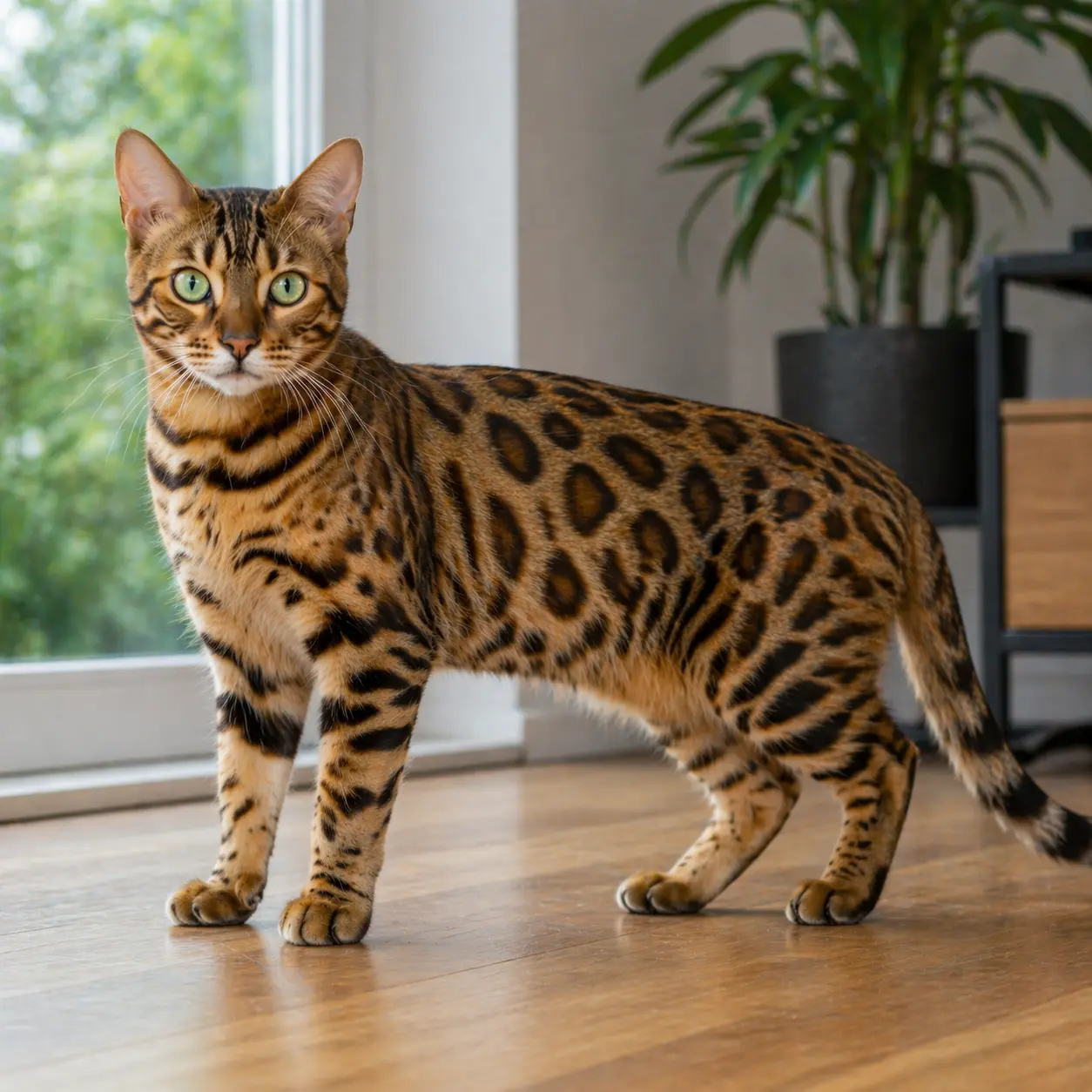 Caption: The Bengal's rosette spots are a specialized form of the spotted tabby pattern — distinct outlined spots rather than solid dots.
2. Solid (Self-Colored)
A solid coat has one uniform color with no visible pattern. No stripes, no spots, no swirls. This is actually a genetically recessive state — the agouti gene must be in its non-functional form (aa) for a solid coat to appear, suppressing the underlying tabby banding.
In strong sunlight, some solid cats show faint "ghost striping" — the underlying tabby pattern becomes visible. This is called tipping or ghost tabby and is completely normal. It does not mean the cat is mixed breed; it means the tabby gene is present but suppressed.
Breed associations by solid color:
- Black — Bombay (developed specifically as an all-black cat), and appears in many breeds
- Blue-gray — Russian Blue (the breed most associated with this specific color)
- White — Turkish Angora, Persian, odd-eyed white cats
- Sable/Brown — Burmese (the original Burmese color is a rich, warm sable brown)
- Lilac/Lavender — British Shorthair, Oriental Shorthair
- Cinnamon — Abyssinian, Oriental Shorthair, Somali
Caption: The Russian Blue's solid coat appears blue-gray but carries silver-tipped guard hairs that give it a characteristic shimmer in light.
3. Pointed (Colorpoint)
The pointed pattern is one of the most genetically distinctive coat patterns in domestic cats. It produces dark coloring on the face mask, ears, paws, and tail — the extremities — while the rest of the body remains pale cream or white.
This pattern is caused by a temperature-sensitive enzyme called tyrosinase, which controls pigment production. The gene that produces pointing is actually a recessive mutation of the standard color gene. When two copies are present, tyrosinase becomes inactive at normal body temperatures but remains active at the cooler extremities. This is why pointed cats are born pale white and develop their color over weeks as the temperature gradient of their body establishes itself.
Point colors in the Siamese family:
| Point Color | Description | Associated Breed Name |
|---|---|---|
| Seal point | Very dark brown, near-black points | Siamese (classic), Ragdoll |
| Chocolate point | Warm milk-chocolate brown points | Siamese, Birman |
| Blue point | Cool blue-gray points on white body | Siamese, Ragdoll, Birman |
| Lilac point | Pale pinkish-gray, warmest point tone | Siamese, Balinese |
| Flame / Red point | Orange-red points | Colorpoint Shorthair |
| Lynx point | Tabby striping within the point areas | Siamese, Ragdoll (lynx variant) |
Breeds that always have pointed coats: Siamese, Ragdoll (all varieties), Birman, Balinese, Tonkinese (partially), Colorpoint Shorthair.
A pointed coat combined with blue eyes is extremely reliable as a breed signal. The same gene that produces pointing also affects eye pigmentation in most cases, though the relationship is not absolute.
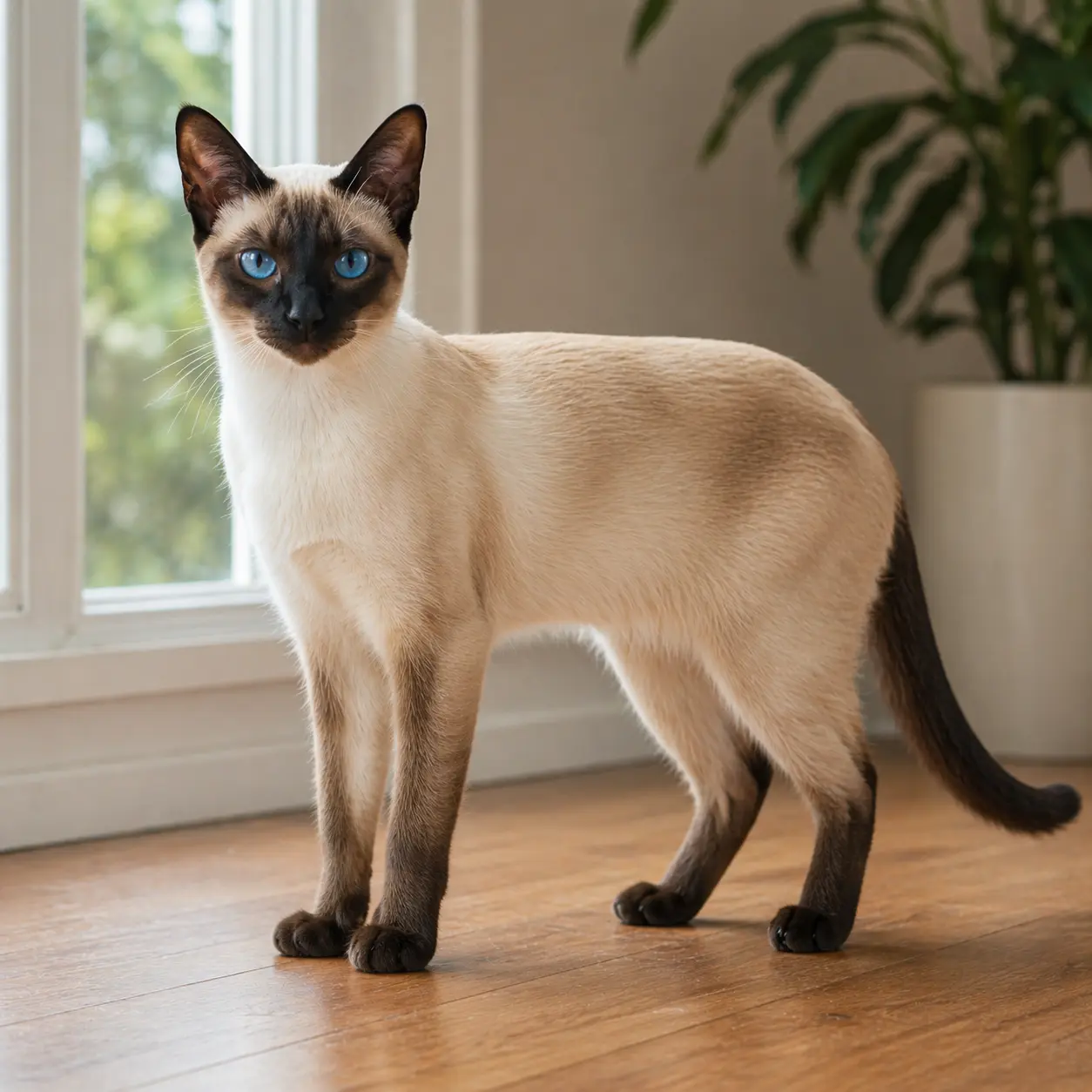 Caption: The Siamese's seal-point coat is the most recognized example of the colorpoint pattern — temperature-sensitive pigment that concentrates at the body's cooler extremities.
4. Bicolor and Tuxedo
Bicolor cats carry the white spotting gene (S), which adds white patches to any base coat color. The degree of white varies enormously — from a small white locket on the chest to nearly full white coverage with just a few colored patches.
The most iconic bicolor pattern is the tuxedo — a black cat with white on the chest, belly, and paws, giving the appearance of formal wear. Tuxedo is not a breed — it is a coat description that can appear in many breeds and most domestic shorthairs.
Degrees of white spotting:
- Low white — small white spots (locket, belly button, toe tips)
- Medium white — tuxedo-style coverage (chest, belly, paws)
- High white — van pattern (mostly white with color only on head and tail)
- Full white — complete white coverage (Turkish Angora, some Persians)
The Turkish Van is notable for its distinctive white body with colored patches restricted to the head and tail — a pattern now called the "Van pattern" after the breed.
Caption: The tuxedo pattern is a medium-expression bicolor — the white spotting gene has covered the chest and underbelly but left the upper body fully black.
5. Tortoiseshell
Tortoiseshell (commonly called "tortie") cats display a mosaic of black and orange (or their dilute versions — blue and cream) with no white or minimal white. The two colors are interspersed throughout the coat in irregular patches.
The tortoiseshell pattern is almost exclusively female. This is because the orange/non-orange gene sits on the X chromosome. For a cat to display both colors, it needs two X chromosomes — one carrying orange and one carrying non-orange. Males typically have only one X chromosome and therefore display only one color. Male tortoiseshells do occur but are extremely rare and almost always sterile (they carry XXY chromosomes).
Dilute tortoiseshell — sometimes called a blue-cream — is the diluted version: blue-gray and cream instead of black and orange.
Tortoiseshell is a pattern that crosses many breeds. It appears in British Shorthair, Persian, Maine Coon, Domestic Shorthair, and dozens of others. A tortoiseshell pattern alone does not signal a specific breed — other features must be read alongside it.
6. Calico
Calico is tortoiseshell plus significant white spotting. A calico cat has three colors: black, orange, and white. Like tortoiseshell, calico is almost always female for the same chromosomal reason.
The distribution of the three colors varies:
- Standard calico — large distinct patches of black, orange, and white
- Dilute calico — blue, cream, and white (softer, pastel appearance)
- Caliby — calico with tabby patterning within the colored patches
Calico is a pattern, not a breed. The Japanese Bobtail is perhaps most culturally associated with the calico pattern — the iconic maneki-neko (lucky cat) figurines are typically depicted as calico. The pattern appears across many breeds and heavily in random-bred domestic cats.
7. Smoke and Shaded
Smoke cats appear solid-colored at first glance, but when the fur parts or the cat moves, a contrasting lighter undercoat becomes visible. In a black smoke cat, the base of each hair is white or silver — the dark color exists only on the outer portion of the hair shaft.
Shaded cats carry an even lighter tipping — less than a third of the hair shaft is colored, producing a bright, glowing appearance. Silver shaded and golden shaded are common in Persians and British Shorthairs.
Shell (chinchilla) is the lightest tipping — only the very tip of the hair carries color, producing an almost white cat with a delicate colored sparkle.
| Pattern Type | Colored Portion of Hair | Visual Effect | Common Breeds |
|---|---|---|---|
| Smoke | Outer half of hair shaft | Appears solid — reveals light undercoat on movement | British SH, Maine Coon, Persian |
| Shaded | Outer third of hair shaft | Bright, glowing coat with visible base | Persian, British SH, Norwegian FC |
| Shell (Chinchilla) | Hair tip only | Nearly white with delicate color sparkle | Chinchilla Persian, British SH |
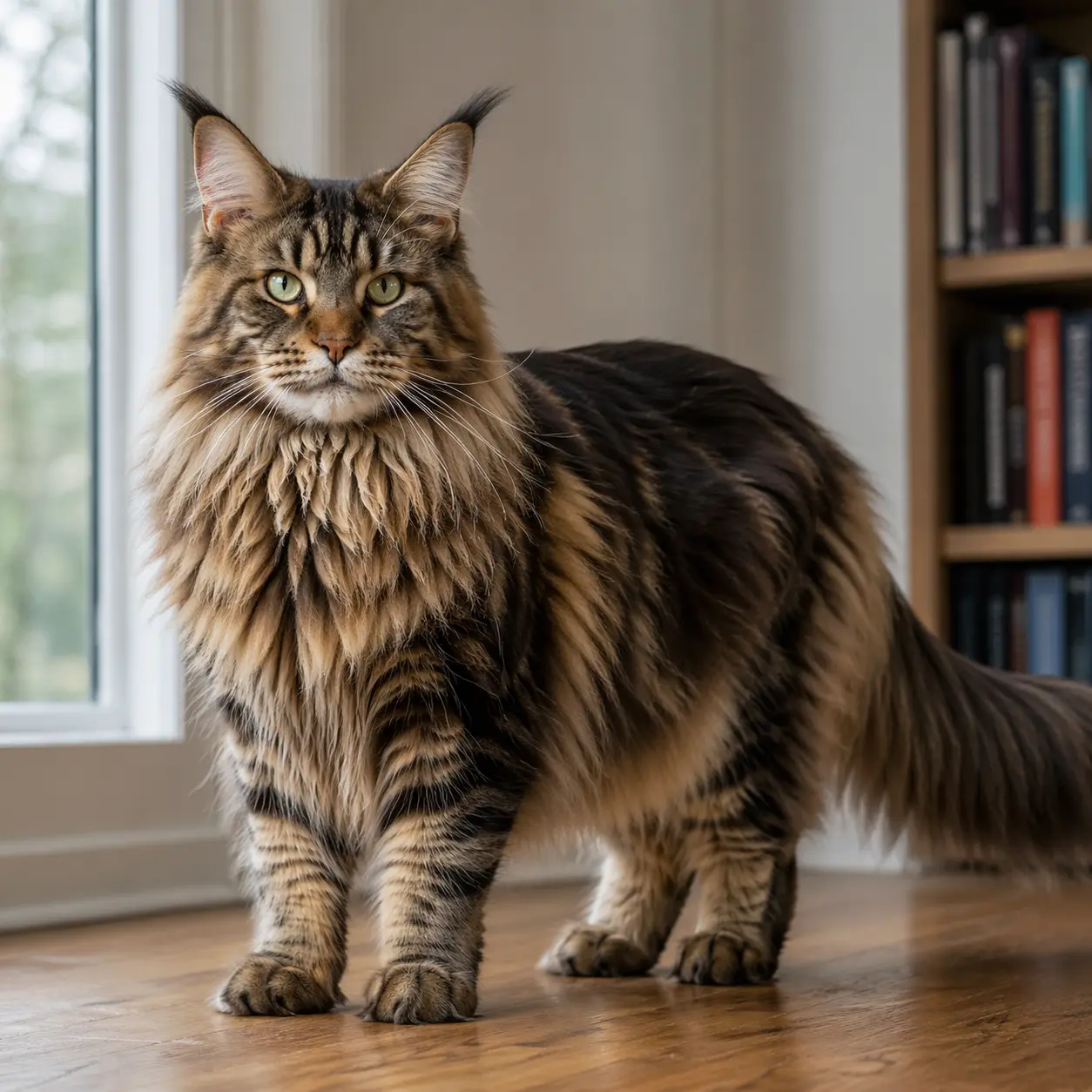 Caption: Maine Coons appear in a wide range of patterns including tabby, solid, smoke, and bicolor — coat pattern alone rarely confirms this breed.
8. Colorpoint Variants: Mink and Sepia
Two patterns related to pointing but less extreme:
Mink (found in the Tonkinese) is produced by one copy of the pointing gene and one copy of the sepia gene. The result is a medium-depth coloring — darker than a classic point but not as dark as a solid coat. Mink cats have aqua-colored eyes.
Sepia (found in the Burmese) is produced by two copies of the sepia gene. The coat is dark and rich — close to solid in appearance — but shows slight darkening on the extremities when examined closely. Burmese have gold or yellow eyes.
These three patterns — pointed, mink, and sepia — exist on a spectrum controlled by the same gene locus, with pointed being the most recessive and sepia the least.
Coat Colors: What Each One Signals
While color is less diagnostic than pattern, certain color-pattern combinations carry strong breed signals.
| Coat Color | Genetic Basis | Strongest Breed Association | Also Appears In |
|---|---|---|---|
| Solid black | Non-agouti + full black pigment | Bombay | Most breeds, domestic SH |
| Solid blue-gray | Black + dilute gene (dd) | Russian Blue, British Blue | Chartreux, Korat |
| Sable/warm brown | Non-agouti + brown modifier | Burmese | Havana Brown |
| Cinnamon | Recessive brown allele (bl) | Abyssinian, Somali | Oriental SH |
| Cream | Orange + dilute gene | Persian (cream), Ragdoll body | Many breeds |
| Silver tabby | Inhibitor gene + mackerel tabby | American Shorthair (classic silver) | British SH, Maine Coon |
| Ruddy/tawny | Agouti + ticked tabby | Abyssinian | Somali |
| Lavender/lilac | Chocolate + dilute | British SH (lilac), Oriental SH | Siamese (lilac point) |
How to Use Coat Pattern in Breed Identification
Coat pattern works best as one layer of evidence — not a standalone conclusion. Here is a practical framework for using it effectively.
Step 1: Identify the Pattern First, Color Second
Look at the structure of the coat before the color. Ask:
- Are there stripes? What kind — thin mackerel or thick classic?
- Are there spots? Are they solid dots or outlined rosettes?
- Is there no pattern at all — just a glowing, even shimmer?
- Are the extremities darker than the body?
- Does the coat look like two colors mixed rather than patterned?
Pattern is more genetically specific than color. Start there.
Step 2: Note What the Pattern Rules Out
Some patterns are near-exclusive to specific breed families:
- Ticked with no stripes → Abyssinian family, almost certainly
- Rosette spots with glitter → Bengal ancestry, very likely
- Color-pointed with blue eyes → Siamese family, strongly indicated
These three patterns are among the most diagnostically reliable coat features in all of cat identification. If you see one of them, you have a meaningful lead.
Step 3: Combine with Physical Features
A ticked coat on a lean, semi-foreign body with large ears is a much stronger signal than a ticked coat alone. Pattern combined with body type, head shape, and eye color builds a converging case. For a full walkthrough of how to combine these signals, the guide on identifying your cat by physical features is a good next step.
Step 4: Consider What You Have Is Mixed Breed
Most cats carry a mix of coat genetics from multiple breed lines. A cat with a faint tabby overlay on a mostly solid dark coat — the ghost tabby effect — is not a failed identification. It is a normal mixed-breed cat whose genetics produced something between a full tabby expression and a solid coat. This is covered in detail in our mixed breed identification guide.
Pattern-to-Breed Quick Reference
| If You See This Pattern | First Breeds to Investigate | Confidence Level |
|---|---|---|
| Ticked coat, no stripes, warm ruddy/gold | Abyssinian, Somali | High |
| Rosette spots + glittery sheen | Bengal | Very High |
| Pointed coat + blue eyes | Siamese, Ragdoll, Birman, Balinese | High |
| Solid blue-gray + green eyes | Russian Blue | Moderate–High |
| Dense solid sable/brown + gold eyes | Burmese | Moderate |
| Classic silver tabby, bold markings | American Shorthair, British SH | Moderate |
| Long, shaggy multi-layer coat, tabby | Maine Coon, Norwegian Forest Cat | Moderate (combine with ear shape) |
| Long dense silky solid or bicolor | Persian, Ragdoll | Moderate (combine with face shape) |
| Tortoiseshell or calico | Many breeds — not diagnostically specific | Low alone |
| Standard mackerel or classic tabby | Many breeds — extremely common | Low alone |
Coat Pattern in Pedigree vs. Mixed Breed Cats
Purebred cats are selectively bred to consistently express specific coat patterns that meet their breed standard. A purebred Abyssinian will always be ticked. A purebred Siamese will always be pointed. A purebred Bengal will always have spots or marble. This consistency is part of what defines a recognized breed.
Mixed breed cats can express any pattern that appears in their genetic background — but the expression may be partial, inconsistent, or modified by competing genes from other ancestral lines. A cat with Siamese ancestry two generations back may show partial pointing — slightly darker extremities without full-depth color contrast. A cat with Bengal ancestry may show spots without the characteristic glitter.
Understanding this gradient of expression is essential for honest mixed-breed identification. You can read more about how breed traits dilute across generations in our breed overview, which covers the most common pedigree cats and their defining traits.
Not sure where to start with your own cat? Our What is My Cat Breed Quiz walks you through a series of questions about your cat's appearance — including coat pattern and color — and gives you a breed result at the end. It takes about two minutes.
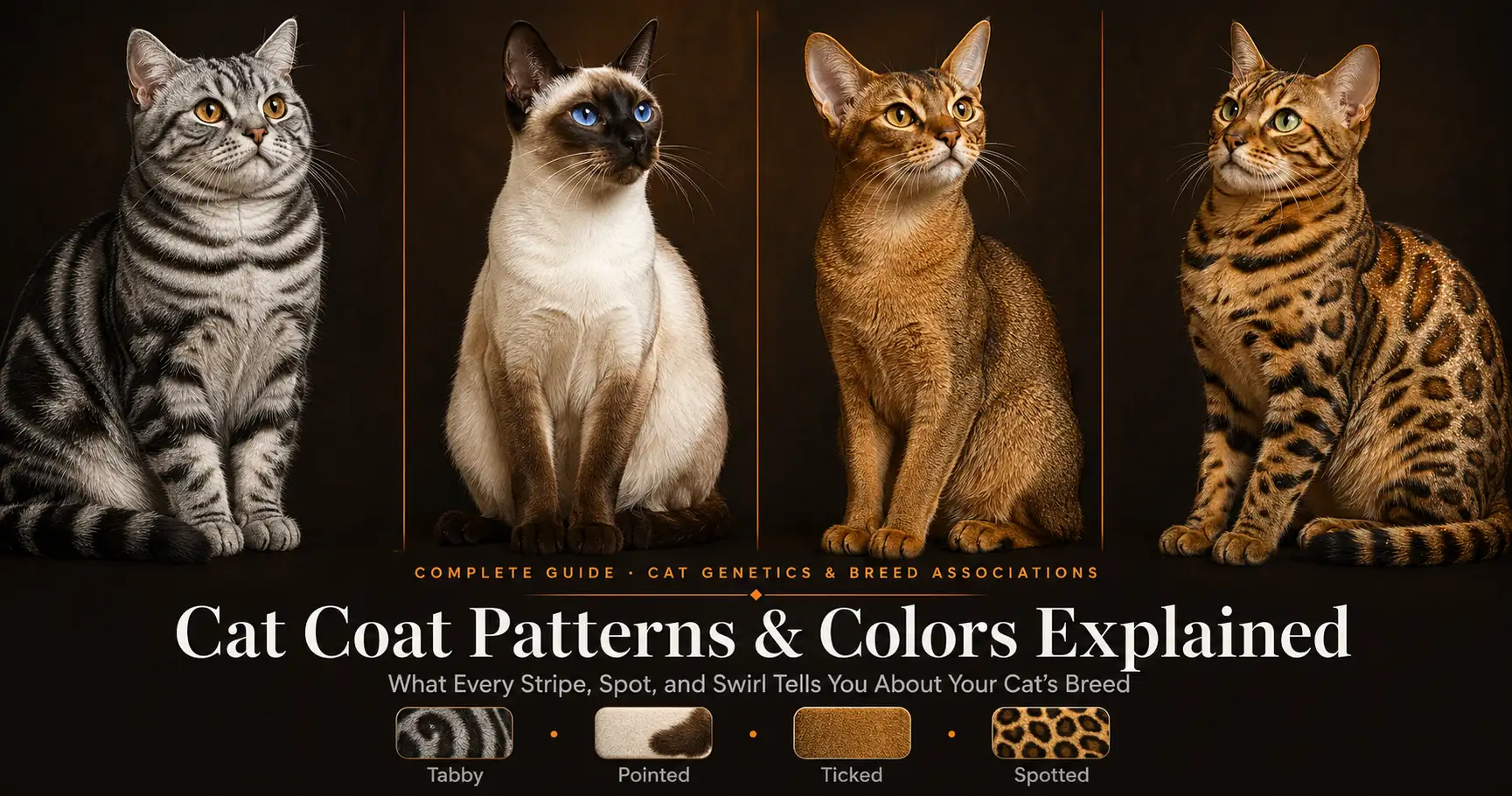
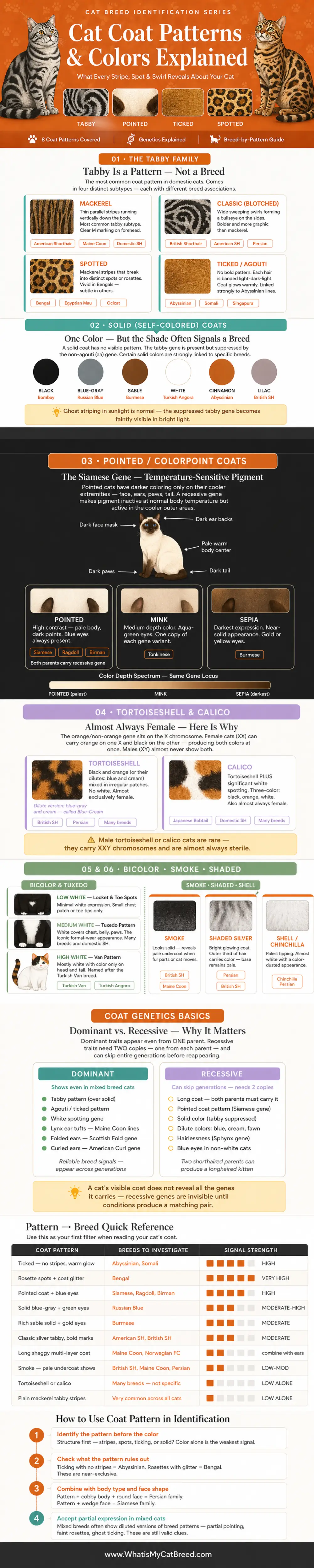
To sum up, the following infographic is prepared as an easy to understand material on cat coats color and patterns and their associations with breeds. Take a look into it, this will stay deep in your mind for long time.
FAQ
Is tabby a cat breed?
No. Tabby is a coat pattern, not a breed. The word "tabby" refers to a family of patterns — mackerel, classic, spotted, and ticked — that are produced by specific genes. These patterns appear in dozens of recognized breeds and in the vast majority of domestic mixed-breed cats. Saying a cat is a "tabby" tells you about its coat, not its breed.
Why is my cat's pattern different in different lights?
Two common reasons. First, ghost striping — even solid cats show faint tabby striping in strong light because the underlying agouti gene is present but suppressed. Second, ticking — on ticked coats, the alternating light and dark bands on individual hairs create a shimmering effect that changes in brightness with the light angle. Neither is unusual or a sign of mixed heritage.
Can two black cats produce a spotted or tabby kitten?
Yes. Two solid-colored black cats can produce tabby or spotted kittens if both parents carry the recessive agouti gene silently. They can also produce kittens of other colors if both carry recessive color genes. What a cat looks like does not reveal what genes it carries — only what genes are expressed in that individual.
Do female cats have different coat patterns than males?
For most patterns, no — males and females express the same patterns equally. The exception is tortoiseshell and calico, which require two X chromosomes to express both orange and non-orange coloring simultaneously. As a result, almost all tortoiseshell and calico cats are female. Male tortoiseshells occur but are genetically rare (XXY) and almost always sterile.
Does my cat's coat color predict its personality?
There is some informal research suggesting mild correlations between coat color and behavior tendencies, but these are not scientifically robust. Breed is a much stronger predictor of personality than coat color in pedigree cats — and in mixed breed cats, individual variation is the dominant factor. Coat tells you about genetics, not temperament.
Coat pattern is your most accessible genetic document. Every stripe, rosette, ticking, and point color in your cat's fur is the expression of inherited genes — some dominant and immediately readable, others recessive and only surfacing under the right conditions. Learning to read those patterns systematically is one of the most satisfying parts of understanding your cat more deeply.
If your cat's coat has you curious about the bigger picture — what breed combination might be behind it, or whether a DNA test is worth considering — find out what breed your cat is by uploading a photo to our identifier tool. It analyzes coat pattern alongside face shape, body type, and eye color to give you the most complete picture available from a single photograph.