Trying to identify your cat's breed by appearance is one of the first things new cat owners want to do — especially when you've adopted a mystery feline from a shelter with no history attached. Every domestic cat (Felis catus) carries physical clues in its body structure, coat, and facial features that point toward its genetic heritage. If you'd rather get an instant answer, our AI Cat Breed Identifier tool lets you upload a photo and get results in seconds. But if you want to understand the why behind the result — read on.
How can I identify my cat's breed by physical features? To identify a cat's breed by physical features, examine five key areas: body shape and size, coat type and pattern, head and facial structure, eye shape and color, and ear and tail characteristics. Each trait is governed by genetics and selectively reinforced through breeding programs recognized by registries like the CFA and TICA. Comparing these traits against documented breed standards gives you a strong indication of your cat's lineage — even without registration papers.
Why Identifying Your Cat's Breed Matters
Knowing your cat's breed — or likely breed mix — is more than a curiosity exercise. Breed characteristics directly influence health predispositions, dietary needs, grooming requirements, and behavioral tendencies.
From a health standpoint, certain breeds carry inherited conditions documented in both The Cat Fanciers' Association (CFA) and The International Cat Association (TICA) breed standards:
- Maine Coons are prone to hypertrophic cardiomyopathy
- Scottish Folds carry a gene linked to osteochondrodysplasia
- Ragdolls can carry the HCM gene variant
Knowing your cat's likely breed gives your vet a framework for proactive screening. It also shapes your relationship with your cat. Understanding how cat breed affects personality and behavior helps you meet their social, physical, and cognitive needs far more effectively.
Reading Your Cat's Body Type and Structure
Feline morphology — the study of a cat's physical form — is one of the most reliable starting points for breed identification. Cat registries use a concept called conformation to describe how a cat's body is built relative to its breed standard. There are three primary body classifications:
Cobby Body Type
Cobby cats are compact, broad, and low to the ground, with short legs, a wide chest, and a rounded overall appearance.
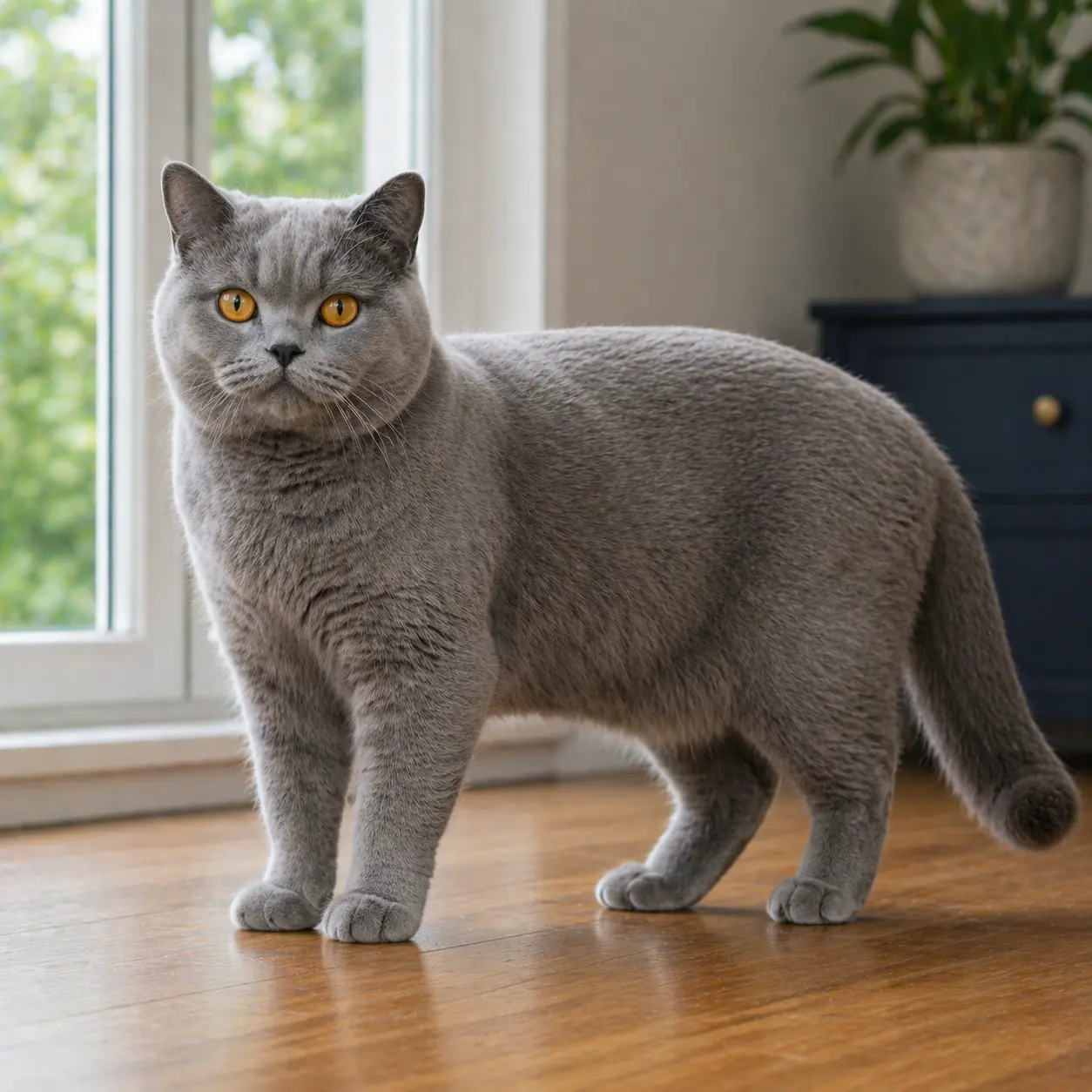
The British Shorthair and Persian are classic examples. If your cat looks stocky, muscular, and solidly built without being large, a cobby breed lineage is likely.
Foreign and Semi-Foreign Body Type
The foreign body type is long, lean, angular, and elegant.
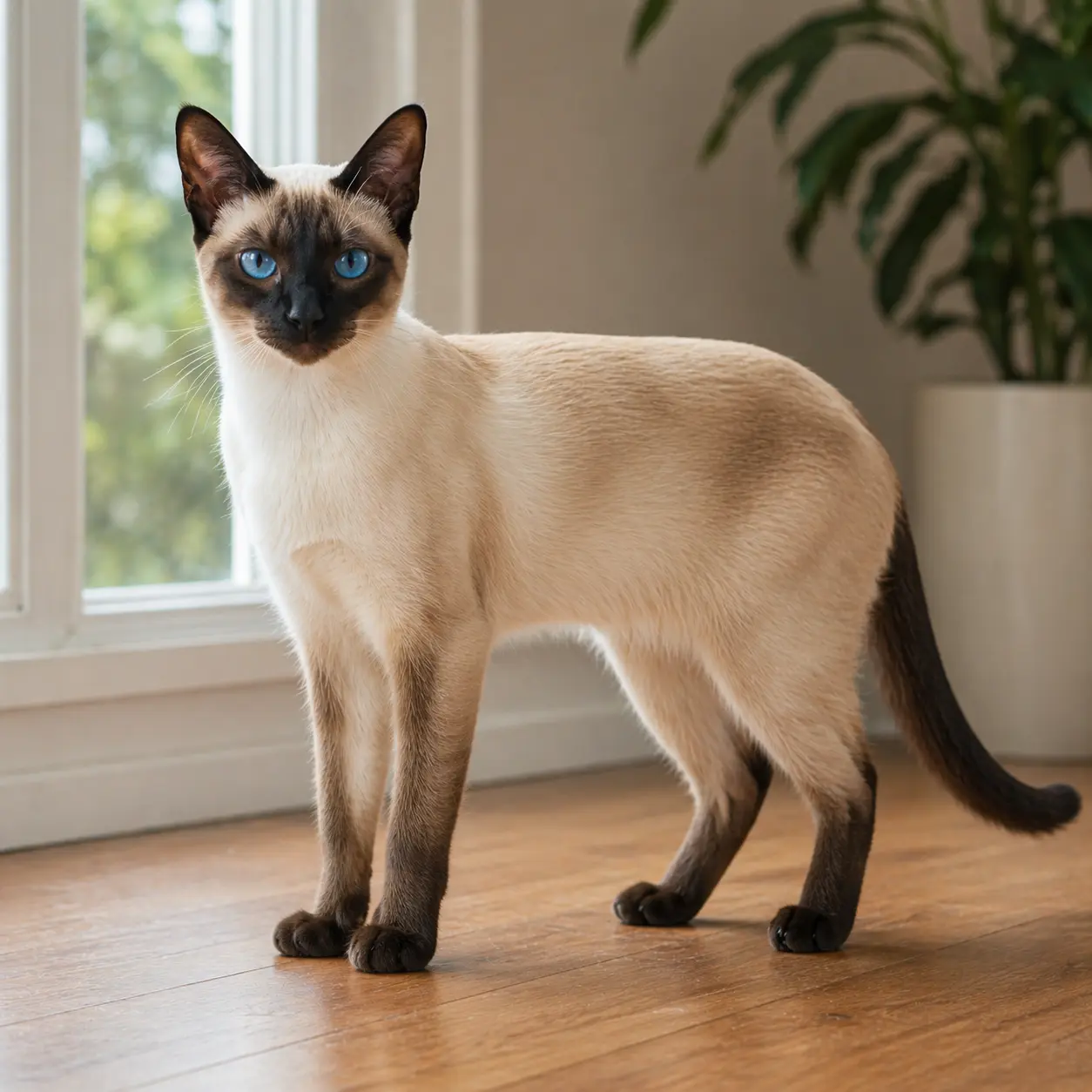
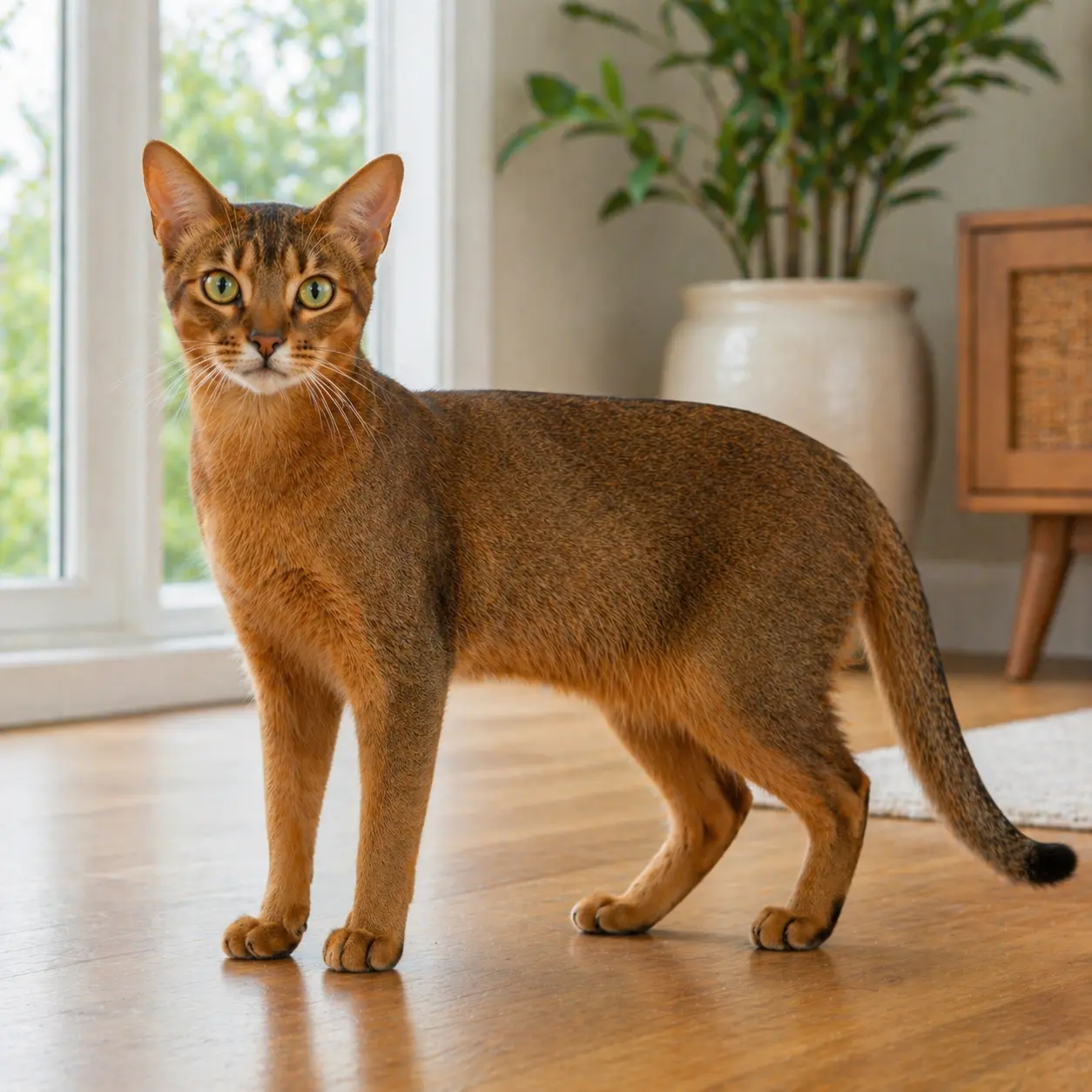
The Siamese is the textbook foreign-type cat — long neck, long limbs, a tapered wedge-shaped head, and a whip-like tail. Semi-foreign cats like the Abyssinian split the difference: athletic and slender but with slightly more substance than extreme foreign builds.
Substantial / Large Body Type
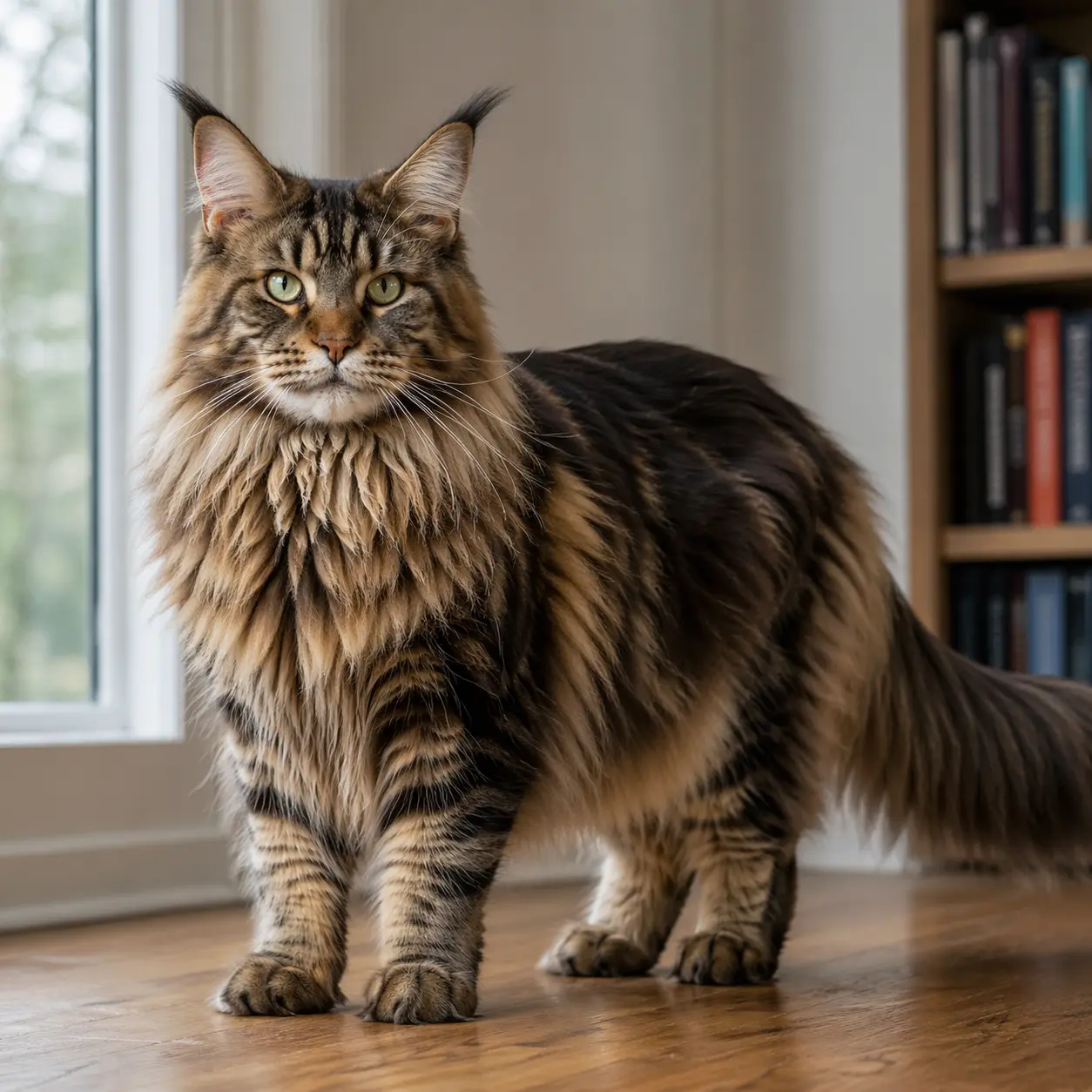
Some breeds simply grow large. The Maine Coon and Norwegian Forest Cat are both substantial, heavily boned cats with strong cat musculature and broad chests. Males of these breeds regularly reach 15–18 lbs without being overweight.
Cat Breed Physical Traits at a Glance
| Breed | Body Type | Coat Type | Head Shape | Distinctive Feature | Weight Range |
|---|---|---|---|---|---|
| Maine Coon | Large, rectangular | Long, shaggy, multi-layered | Square muzzle, high cheekbones | Ear tufts (lynx tips), bushy tail | 10–18 lbs |
| Siamese | Foreign — long, lean | Short, fine, pointed | Wedge-shaped, triangular | Color-point pattern, blue eyes | 6–10 lbs |
| Persian | Cobby, compact | Long, dense, silky | Flat, round (brachycephalic) | Flat face, snub nose, large eyes | 7–12 lbs |
| Bengal | Athletic, muscular | Short, dense, spotted/marbled | Broad, rounded contours | Leopard-like rosette markings | 8–15 lbs |
| British Shorthair | Cobby, broad | Dense, plush, short | Round, full-cheeked | "Teddy bear" face, copper eyes | 9–18 lbs |
| Ragdoll | Large, semi-cobby | Semi-long, silky, low-mat | Broad, modified wedge | Goes limp when held, blue eyes | 10–20 lbs |
What Your Cat's Coat Pattern and Color Reveals About Its Breed
Coat genetics in cats are surprisingly complex. Mendelian inheritance in cats governs the expression of color, pattern, and length through dominant and recessive alleles. Understanding even the basics can dramatically narrow down which breeds may be present in your cat's lineage.
Pointed Coats
The pointed coat — dark coloring on the face, ears, paws, and tail contrasting with a lighter body — is most closely associated with the Siamese and its descendants (Ragdoll, Birman, Balinese). This pattern is controlled by a temperature-sensitive enzyme that restricts pigment to the cooler extremities.
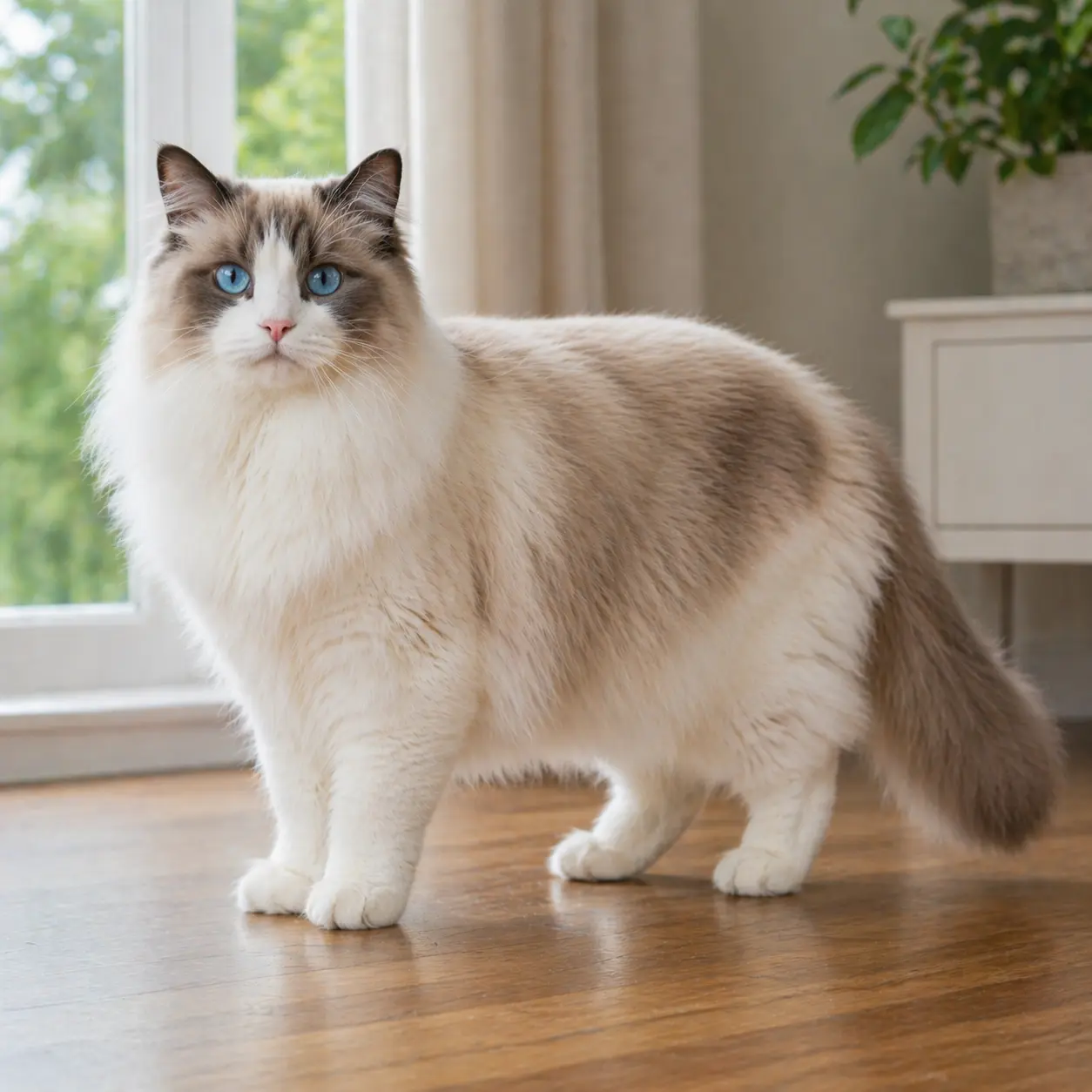
- If your cat has a pointed pattern and blue eyes, Siamese heritage is a strong candidate
Ticked Coats and the Agouti Gene
A ticked coat means each individual hair has alternating bands of light and dark pigment — a trait regulated by the agouti gene. The Abyssinian is the breed most famous for its ticked coat, giving it a warm, luminous appearance without obvious stripes or spots.
- If your cat has no bold pattern but a rich, shimmering coat that shifts in light, ticked genetics may be at play
Spotted and Marbled Patterns
Wild-looking spotted or marbled patterns — especially with a glittery sheen — are strongly associated with the Bengal, a breed developed through crossing domestic cats with the Asian leopard cat.
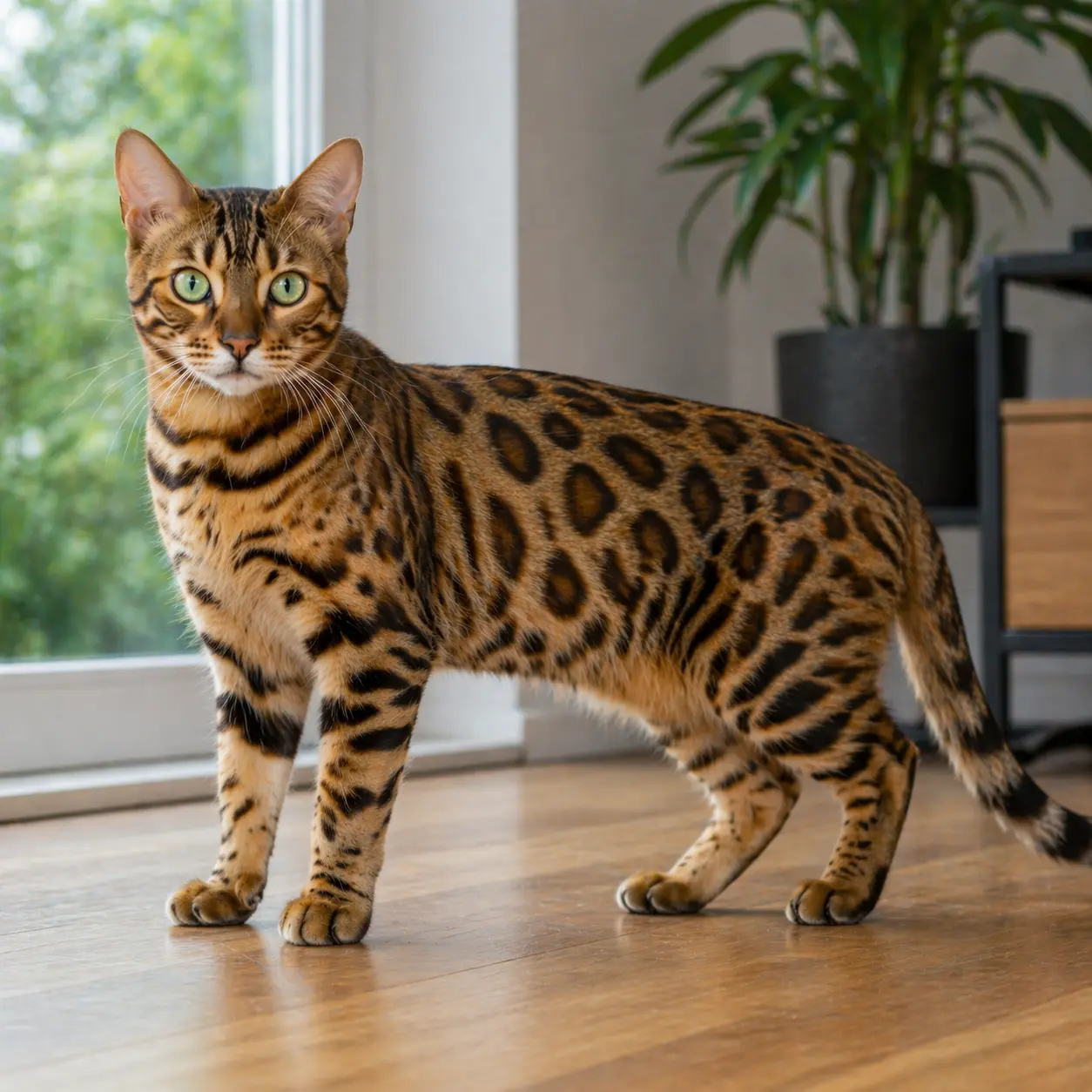
For a deeper dive into all pattern types, see our guide to cat coat patterns and their breed associations.
Facial Features That Point to Specific Breeds
The face is often the most immediately recognizable part of a pedigreed cat's appearance. Selective breeding over generations has produced highly distinct facial structures that serve as reliable breed identifiers.
Brachycephalic (Flat-Faced) Cats
Brachycephalic cats have skulls shortened front-to-back, producing the characteristic flat face, snub nose, and large, round eyes.
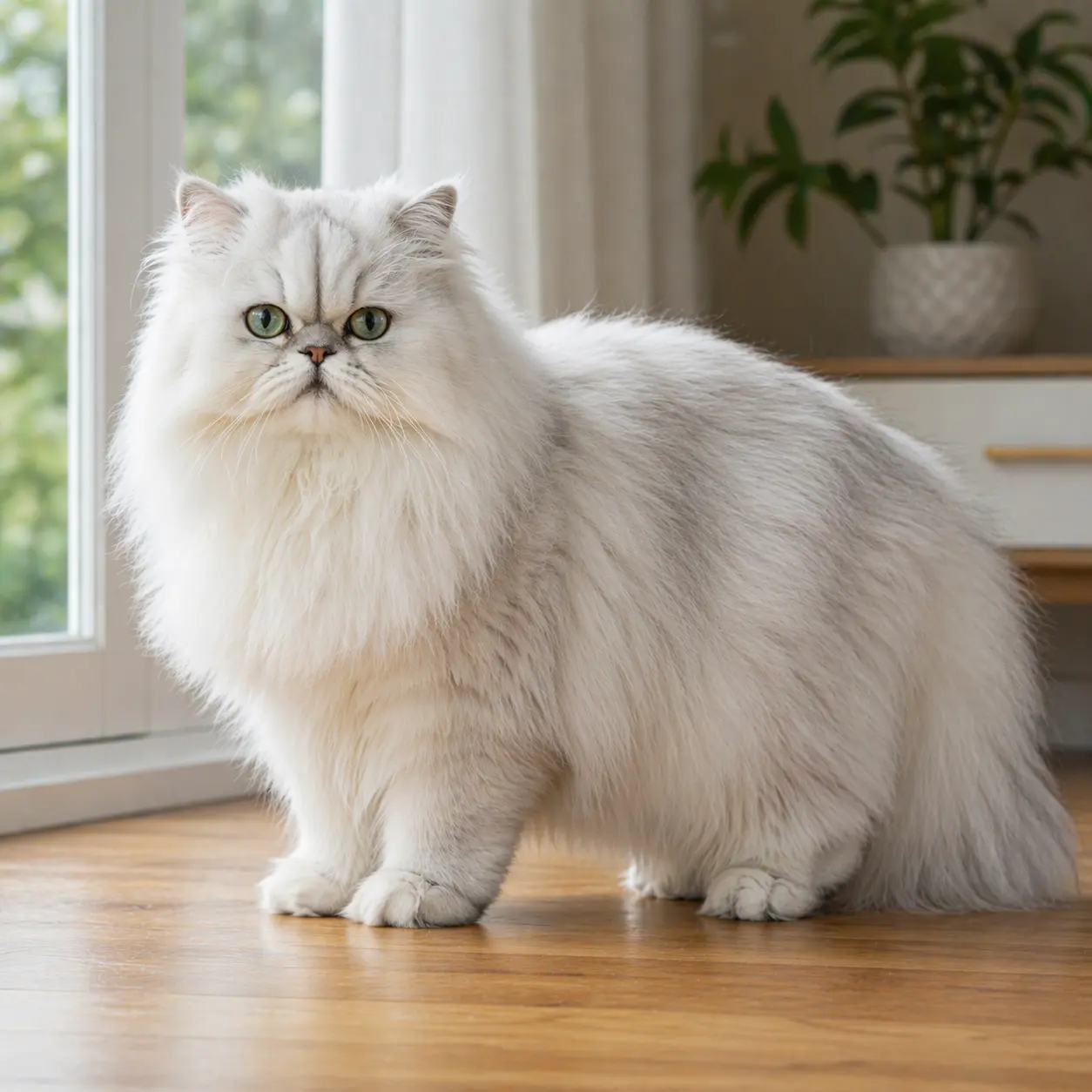
Flat-faced breeds include:
- Persian — the most recognized example
- Scottish Fold — also exhibits flattened facial features
- Exotic Shorthair — a shorthaired Persian variant
If your cat's nose barely protrudes from its face and its eyes look perpetually large, brachycephalic ancestry is highly plausible.
Wedge-Shaped and Angular Faces
A long, angular, wedge-shaped head that narrows sharply from the ears to the muzzle points strongly toward the Siamese family. These cats tend to have:
- Prominent cheekbones
- Large ears set wide on the skull
- A straight nose profile with no break
Oriental Shorthairs, Cornish Rex, and Sphynx cats also share variations of this elongated skull structure.
Round-Headed Cats
Round-headed cats — distinct from flat-faced — have a gently curved skull without extreme foreshortening. The British Shorthair exemplifies this: a fully rounded head with full cheeks, a short straight nose, and a strong chin, giving it an iconic owl-like expression.
Eye Shape, Color, and What They Tell You
Eye characteristics are highly breed-specific and often the most striking visual feature of a pedigreed cat. Two components matter: shape and color.
Eye Shape by Breed
| Eye Shape | Associated Breeds |
|---|---|
| Almond-shaped, oblique | Siamese, Abyssinian, Egyptian Mau |
| Large and round | British Shorthair, Persian, Scottish Fold |
| Lemon-shaped | Sphynx |
| Oval, moderately large | Maine Coon, Norwegian Forest Cat |
Eye Color Signals
- Blue eyes in non-white cats are almost always linked to the pointed pattern gene — Siamese, Ragdoll, Birman
- Copper or gold eyes are strongly associated with cobby breeds like the British Shorthair
- Odd-eyed cats (one blue, one gold) appear most commonly in Turkish Angoras and Van cats
- The Ragdoll is defined in part by its deep, vivid blue eyes regardless of coat variety
Tail Length and Ear Shape as Breed Clues
Ear Characteristics
Ear shape is one of the most genetically distinctive traits a cat can carry:
- Ear tufts (lynx tips) — hair extending beyond the ear tip — are a hallmark of the Maine Coon and Norwegian Forest Cat
- Large, wide-set ears on a triangular skull are classic Siamese
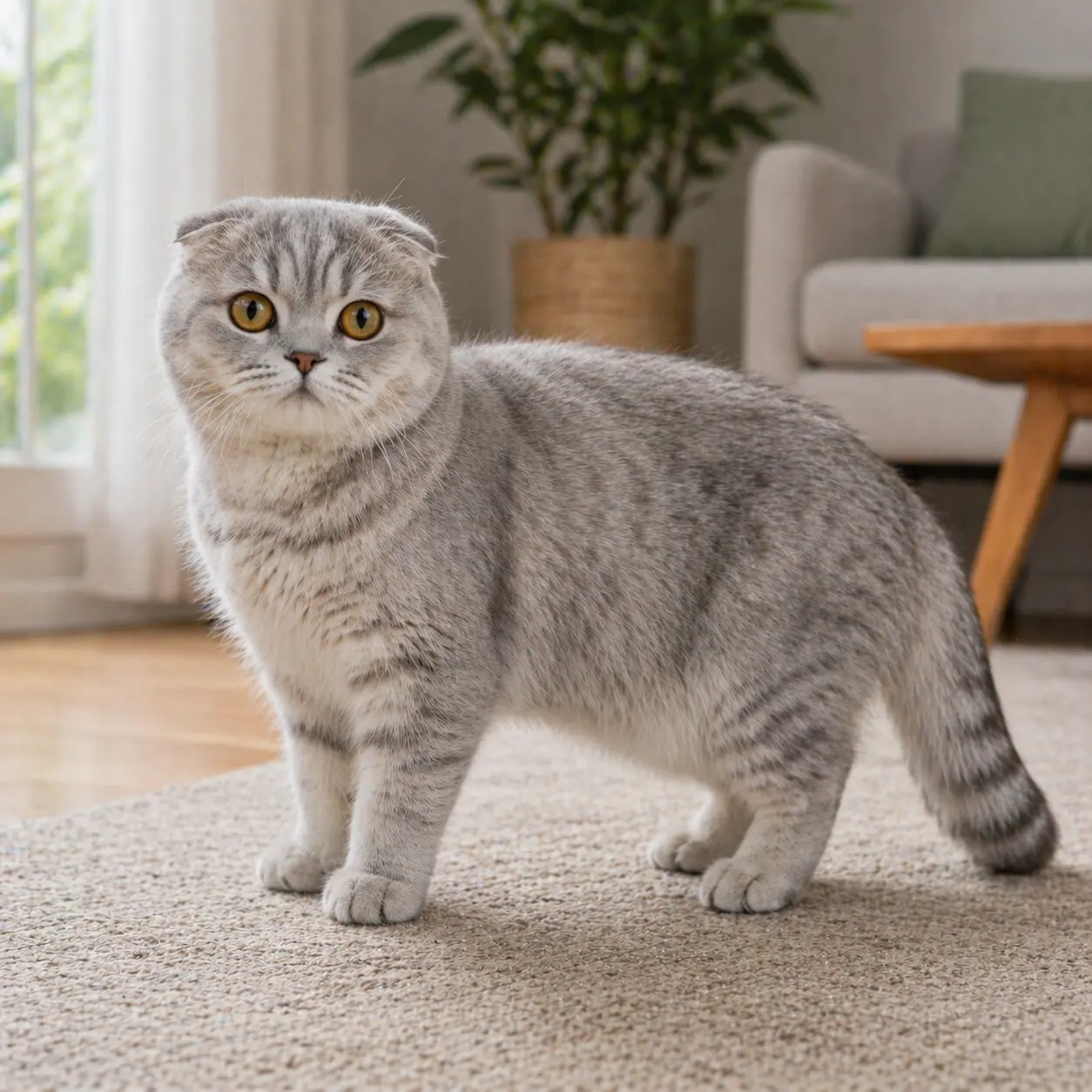
- Folded-forward ears caused by a dominant cartilage mutation are an almost unmistakable marker of Scottish Fold genetics
- Curled-back ears point toward the American Curl
Tail and Paw Features
- Maine Coon — long, thick, fully plumed tail designed to wrap around the body for warmth
- Siamese — long and whip-thin tail
- A naturally bobbed or kinked tail may indicate Japanese Bobtail or Manx heritage
- Polydactyl cats (extra toes) are strongly associated with certain Maine Coon lines, though polydactyly can appear in many mixed-breed cats
When Physical Features Alone Aren't Enough
Physical identification has real limits. The vast majority of owned cats worldwide are domestic shorthairs or domestic longhairs — informal terms for cats of mixed or unknown ancestry that display no consistent breed standard. These cats can carry a single striking physical trait — tufted ears, blue eyes, a spotted coat — that suggests a purebred ancestor several generations back, without being a recognizable breed themselves.
If your cat's features seem inconsistent — a cobby body with a pointed coat, or large ears with a round head — you're likely looking at a mixed-breed cat that inherited different traits from different ancestors. Our mixed breed cat identification guide covers how to interpret these combinations systematically.
It's also important to understand what physical traits can and cannot tell you:
- ✅ They can suggest probable ancestry and breed characteristics
- ✅ They can help you anticipate health and behavioral tendencies
- ❌ They cannot confirm whether your cat is purebred or mixed breed without documentation
- ❌ They cannot provide a definitive genetic breakdown
For a definitive genetic answer, DNA testing for cats is the most scientifically reliable route — though physical identification remains a practical and valuable first step.
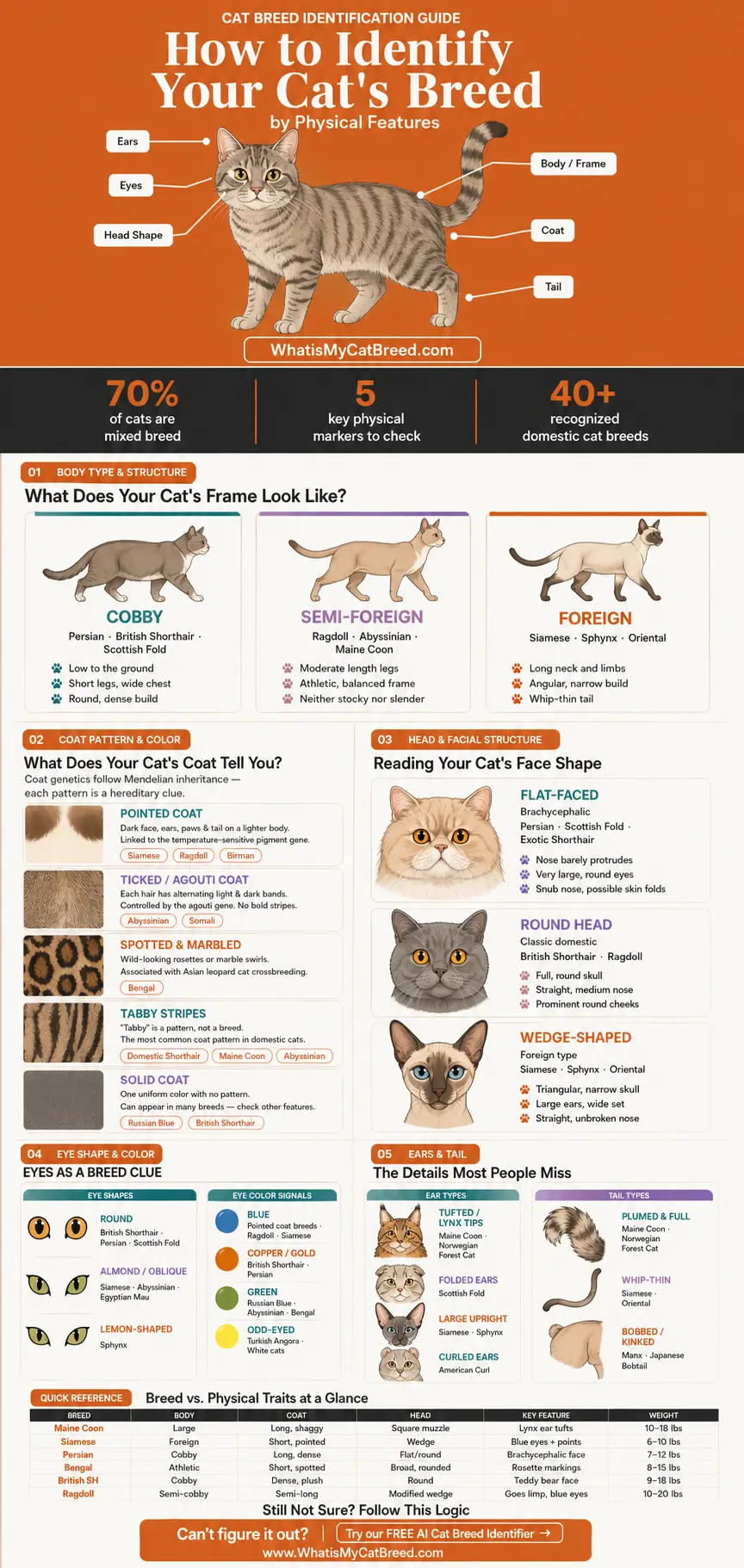
An Infographic on How to Identify your Cat's Breed
Take a look into the self-explanatory infographic that will guide you through to understand basics of cat's breed identification.
Frequently Asked Questions
How can I tell what breed my cat is without papers?
Without registration papers, the most practical approach is to systematically assess your cat's physical traits — body type, coat pattern and length, head shape, eye characteristics, and ear structure — then compare them against documented breed standards from the CFA or TICA. AI-based breed identifier tools and cat DNA tests are also reliable options for going beyond visual assessment.
Can I identify my cat's breed from a photo?
Yes. A clear, well-lit photo showing your cat's full body and face provides enough visual data for AI tools to analyze physical features and return breed probability matches in seconds. For best results, use natural light and a side or three-quarter angle that shows both the full body and face clearly.
What physical features distinguish cat breeds from each other?
The primary physical features used to distinguish cat breed characteristics are:
- Body conformation — cobby, foreign, or substantial build
- Coat type and pattern — pointed, ticked, spotted, or tabby
- Head shape — round, wedge, or flat (brachycephalic)
- Eye shape and color
- Ear structure — upright, folded, tufted, or curled
- Tail characteristics — length, thickness, and whether naturally bobbed
Is my cat a purebred or a mixed breed?
Most cats without registration paperwork are mixed breeds, even if they display strong characteristics of a specific breed. Truly purebred cats are documented through certified registries (CFA or TICA) with a traceable pedigree. A cat DNA test provides the most objective answer — physical features alone cannot make this determination definitively.
What is the most accurate way to identify a cat's breed?
The most accurate method is a feline DNA test, which analyzes your cat's genetic markers against a reference database of known breed profiles. For most pet owners, combining careful physical assessment with an AI-based breed identifier provides a very strong indication without the cost of genetic testing. Veterinarians can also offer an informed opinion based on breed-specific anatomical traits during a routine examination.