Your cat does something strange with its tail. Or it has one tufted ear and one that sits flat. Or its coat shifts color in sunlight in a way that no solid tabby should. You've looked at breed charts. Nothing quite fits. That's because your cat is probably a mixed breed — and mixed breed cat identification is a different puzzle from matching a purebred to a standard.
Most cats in homes and shelters worldwide carry genetics from two, three, or more breed lines. Understanding what those lines might be isn't just satisfying — it helps you understand your cat's behavior, health tendencies, and care needs. If you want to understand how to read the clues of mixed breed cats, this guide walks you through every method available.
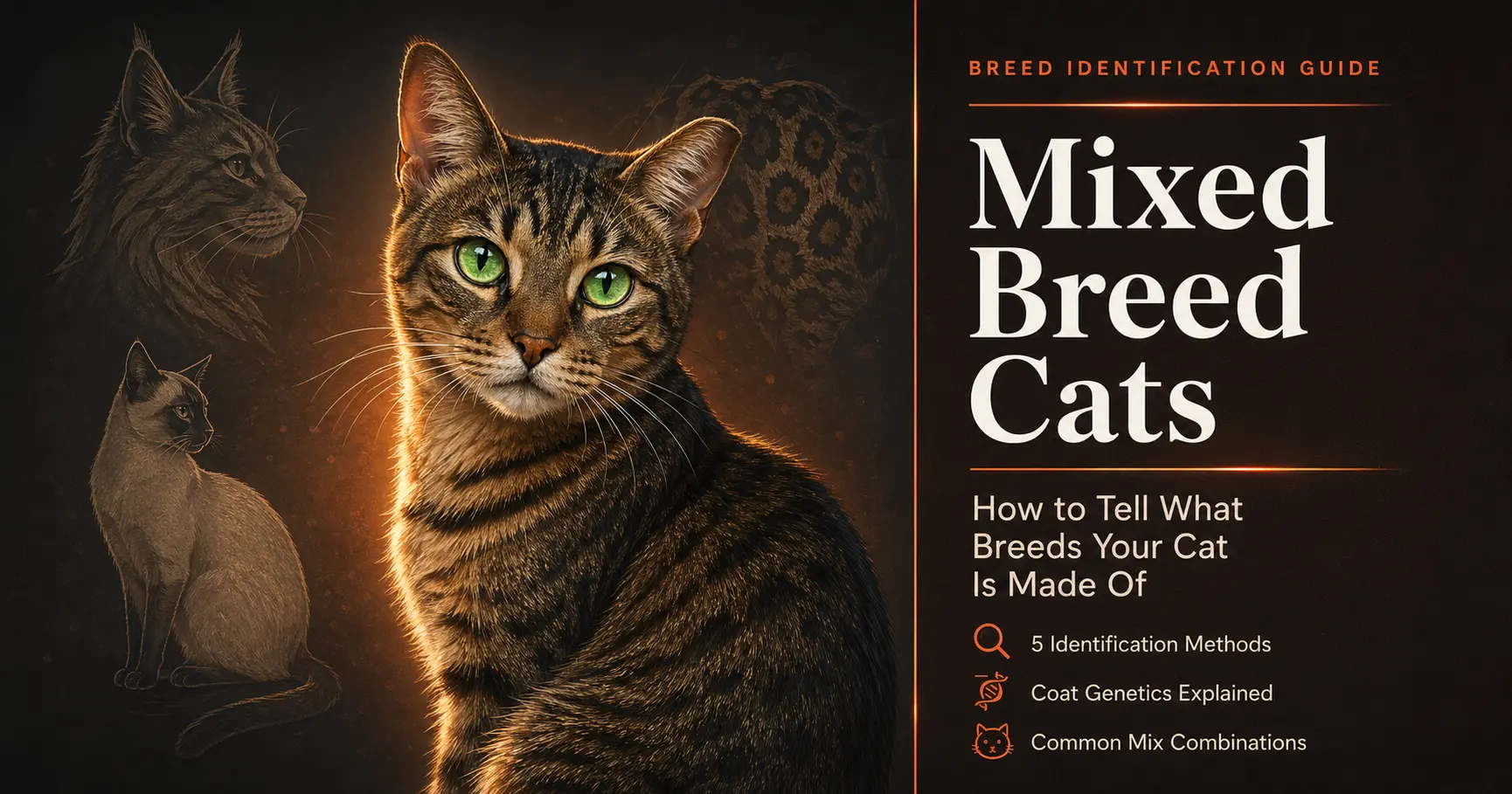
What "Mixed Breed" Actually Means
A mixed breed cat — sometimes called a moggy, a domestic shorthair, or a domestic longhair — is any cat without a documented pedigree. That's it. It doesn't mean the cat looks generic or has no identifiable traits. It simply means no one tracked which cats produced which kittens across generations.
What that produces is fascinating genetic variety. A mixed breed cat can carry the pointed coat gene of a Siamese ancestor, the tufted ears of a Maine Coon three generations back, the ticked coat pattern of an Abyssinian, and the round cobby body of a British Shorthair — all in one animal. Some of those traits surface visibly. Others stay hidden, recessive, passed on without expression.
The (CFA) and (TICA) recognize over 40 pedigree breeds. Any cat outside that documented system is, by definition, a mixed breed — regardless of how strongly it resembles a specific breed.
Important distinction: A cat that looks like a Bengal is not a Bengal. It may carry Bengal ancestry. It may carry the same coat gene that Bengals are selected for. But without a traceable pedigree, it remains a mixed breed cat with Bengal-like features. These are meaningfully different things.
Method 1: Read the Physical Features
Physical traits are your first and most accessible tool. Cats inherit physical characteristics through Mendelian coat genetics and polygenic inheritance — meaning some traits follow predictable dominant and recessive patterns, while others result from combinations of multiple genes.
Here's how to work through the main physical categories systematically.
Body Type and Size
Start with the frame. Strip away the coat in your mind and look at the skeleton underneath.
Cobby cats are compact, wide-chested, and low to the ground with short legs. If your mixed breed cat has this build, breeds like Persian, British Shorthair, Scottish Fold, or Exotic Shorthair may be in the background. Cobby cats tend to feel heavier than they look.
Foreign-type cats are long, lean, and angular. Long legs, a long neck, a narrow head. If this describes your cat, Siamese, Abyssinian, Oriental Shorthair, or Burmese ancestry is plausible. These cats move fluidly and tend to be lighter than their energy levels suggest.
Large, substantial cats with heavy bone structure and a rectangular body often carry Maine Coon or Norwegian Forest Cat ancestry. If your mixed breed male exceeds 14 lbs without being overweight, large-breed genetics are almost certainly present somewhere.
Medium, athletic builds that don't fit neatly into any extreme category are the most common. These cats may carry a mix of body-type genetics that cancel each other out — producing something functional and balanced but breed-ambiguous.
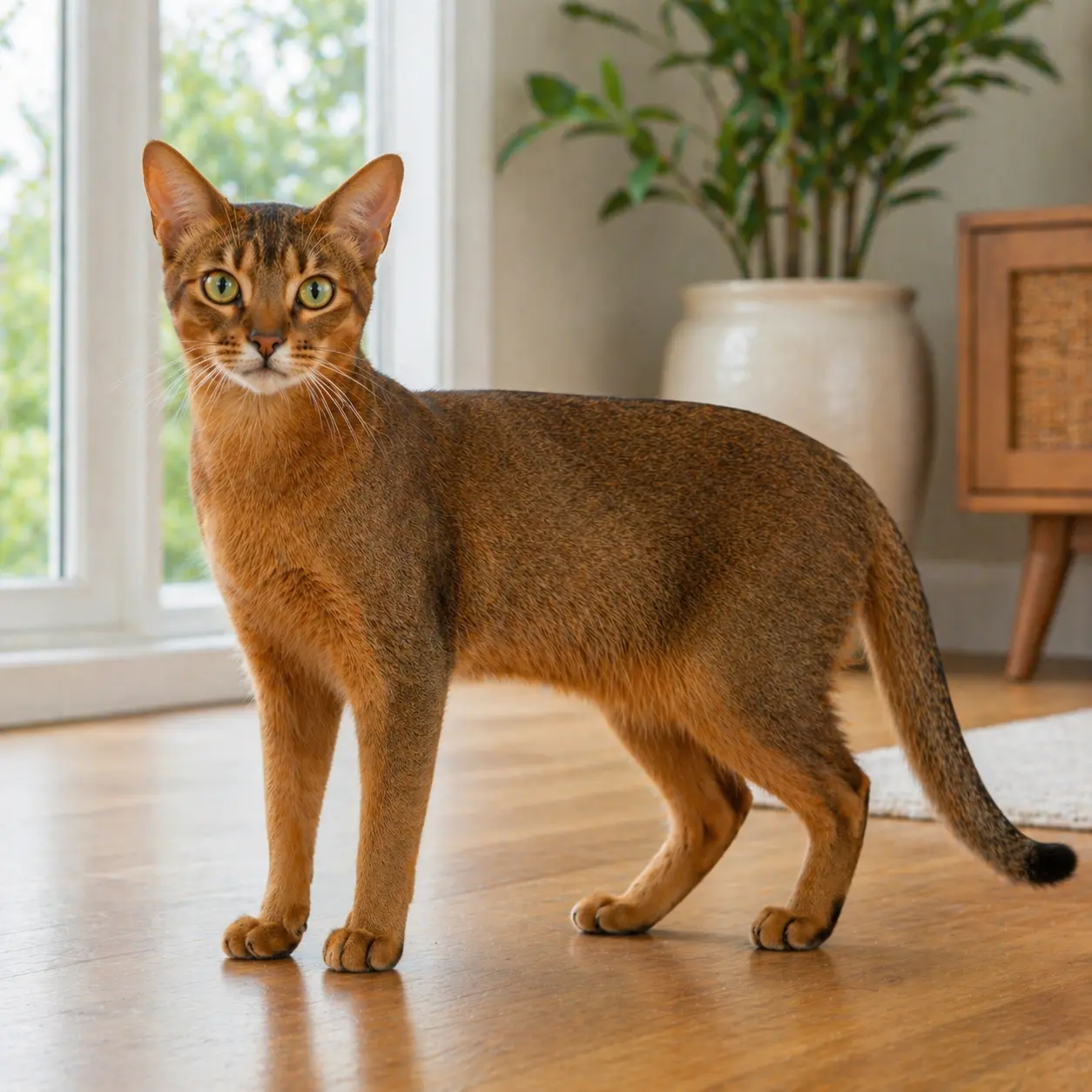 Caption: The Abyssinian's distinctive ticked coat and semi-foreign build are traits that surface clearly even in mixed breed cats with Abyssinian ancestry.
Coat Length and Texture
Coat length follows a relatively simple genetic rule: long coat is recessive. A cat must inherit the long-coat gene from both parents to express it. This means a long-haired mixed breed cat almost certainly has long-haired ancestry on both sides — or two short-haired parents who both carried the recessive gene silently.
Short coats in mixed breeds can come from virtually any breed background. Texture is more informative:
- Plush, dense, stand-off coat — suggests British Shorthair, American Shorthair, or Russian Blue influence
- Fine, close-lying, silky coat — points toward Siamese, Burmese, or Cornish Rex background
- Coarse, water-resistant outer coat over a woolly undercoat — signals Maine Coon or Norwegian Forest Cat genetics
- Wavy or curly coat — almost always indicates Devon Rex or Cornish Rex somewhere in the lineage, as the curling gene is quite distinctive
- Sparse, minimal coat — could reflect Sphynx ancestry, though full hairlessness requires two copies of the recessive gene
Coat Pattern and Color
This is where coat genetics gets genuinely useful for mixed breed identification. Certain patterns are strongly linked to specific breed families, and because these patterns follow Mendelian inheritance, they can appear clearly even in cats several generations removed from a purebred ancestor.
Pointed pattern — a lighter body with darker coloring on the face, ears, paws, and tail — traces almost exclusively to the Siamese family. This includes Siamese, Birman, Balinese, Ragdoll, and Colorpoint Shorthair. If your mixed breed cat has a pointed coat and blue eyes, Siamese-family ancestry is virtually certain. The gene responsible (a temperature-sensitive enzyme that restricts pigment to the body's cooler extremities) is distinctive and doesn't arise spontaneously.
Ticked coat — where each individual hair carries alternating light and dark bands with no bold stripes or spots visible — is controlled by the agouti gene and is most strongly associated with the Abyssinian and its descendants (Somali, Singapura). A ticked mixed breed cat with a warm ruddy or golden coat is very likely carrying Abyssinian genetics.
Rosette or marbled spotting — especially with the characteristic glittery sheen — points strongly to Bengal ancestry. The rosette pattern (spots outlined like a leopard's) is not common in natural random-bred cats and usually indicates Asian leopard cat hybrid genetics somewhere in the line.
Tabby stripes (mackerel or classic swirls) are the most common pattern in all cats and are less diagnostically useful — they appear across dozens of breeds and in random-bred cats equally.
Solid coloring with a dense, even tone can appear in many breeds, but certain colors carry breed signals. A solid blue-gray coat with silver-tipped hairs and green eyes strongly suggests Russian Blue ancestry. A rich, warm sable brown with golden eyes points toward Burmese.
For even more detailed instructions on how to identify a cat's breed through physical features/traits, check out this guide in which we covered every step in details.
Method 2: Study the Face
The face is often the most powerful indicator of breed heritage in a mixed cat. Facial structure is strongly influenced by genetics and remains readable even in multi-generation mixes.
Head Shape
Work out your cat's head shape as one of three basic types.
A round head with full cheeks, a short nose, and a strong chin points toward British Shorthair, Ragdoll, or Scottish Fold ancestry. These cats have a distinctly "owl-faced" quality.
A wedge-shaped head — triangular, narrowing from large-set ears to a pointed muzzle — signals Siamese, Oriental, or Abyssinian in the background. The more extreme the wedge, the stronger the connection to the Siamese family.
A flat, brachycephalic face where the nose barely protrudes and the eyes appear very large and round suggests Persian, Exotic Shorthair, or Scottish Fold ancestry. Even in a mixed breed cat, partial brachycephaly often shows — a slightly shortened nose, a broader-than-average skull, or eyes positioned more forward than typical.
Eyes
Eye shape and color both carry breed signals.
- Almond-shaped eyes set obliquely on the skull — Siamese, Abyssinian, Egyptian Mau ancestry
- Large, round eyes — British Shorthair, Persian, Scottish Fold
- Oval, moderately large eyes — Maine Coon, Norwegian Forest Cat, Ragdoll
Eye color matters when it appears in specific combinations:
- Blue eyes in a non-white cat nearly always trace to the pointed coat gene — which means Siamese-family ancestry
- Vivid green eyes with a silver-blue coat — Russian Blue influence
- Odd eyes (one blue, one gold) appear most in Turkish Angora or Van cat backgrounds
- Deep copper or orange eyes paired with a dense plush coat — British Shorthair or Persian ancestry
Ear Structure
Ears are one of the most diagnostically reliable features in mixed breed identification, because certain ear traits are controlled by highly specific genes.
- Lynx tips (tufts of hair extending beyond the ear tip) — strongly associated with Maine Coon and Norwegian Forest Cat. This trait is dominant and visible even in first-generation mixes.
- Folded-forward ears — an unmistakable marker of Scottish Fold genetics. The cartilage mutation that causes folding is dominant, meaning one copy of the gene produces the fold. If your cat has any degree of forward-folded ear, Scottish Fold ancestry is almost certain.
- Very large, wide-based ears set high and wide on a narrow skull — Siamese, Sphynx, or Oriental influence
- Curled-back ears — American Curl ancestry. Like the fold gene, this is dominant and shows clearly even in mixed cats.
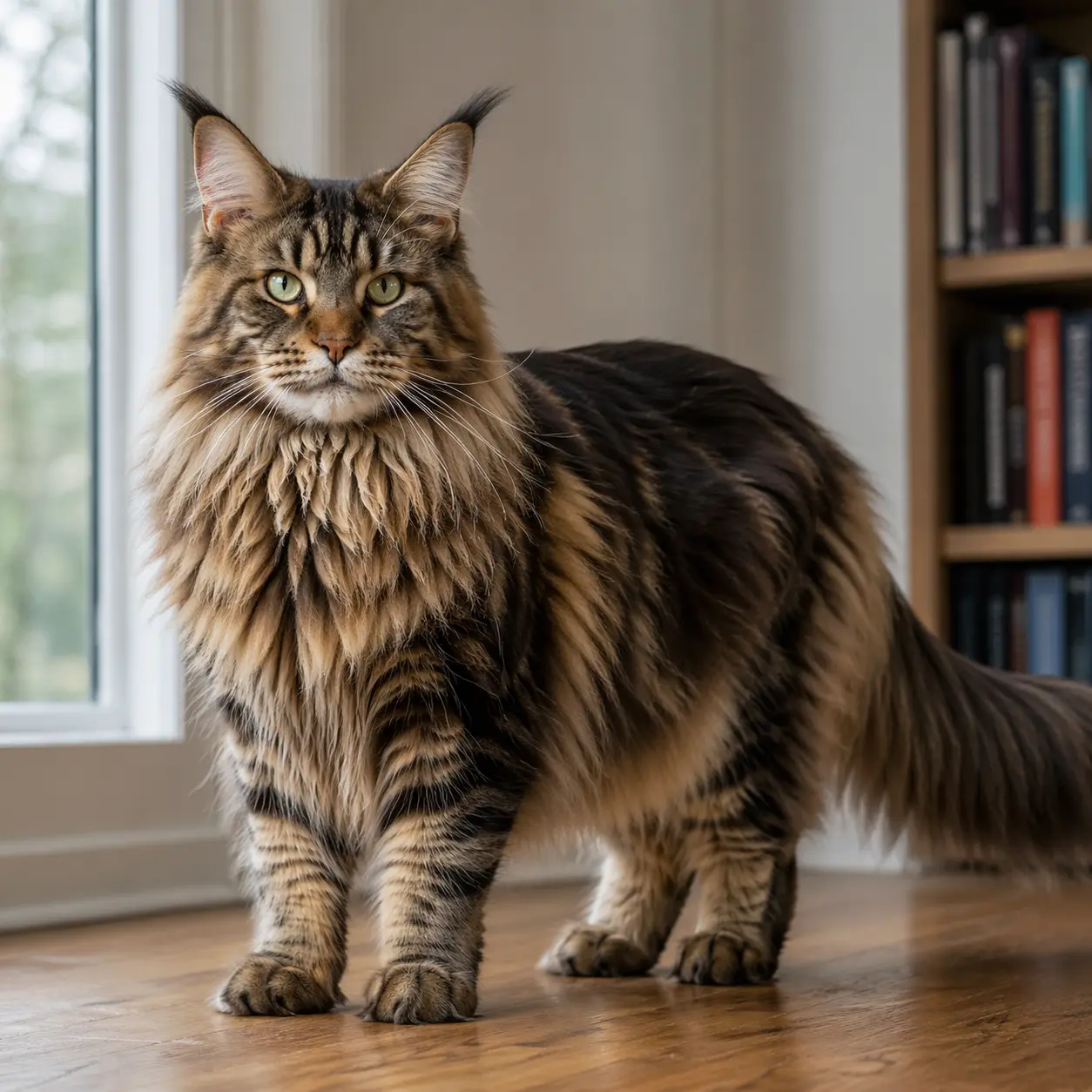 Caption: Lynx ear tufts like these can appear in mixed breed cats with even a partial Maine Coon ancestor — they're one of the most dominant and visible breed markers.
Method 3: Watch the Behavior
Behavior is not a reliable primary identifier — any individual cat can defy breed tendencies. But behavioral patterns, when they align consistently with physical clues, add meaningful weight to an identification hypothesis.
This is covered in much greater depth in our guide to how cat breed affects personality and behavior, but here are the key behavioral signals worth noting in mixed breed identification.
Extreme vocalization — loud, frequent, conversational — is a Siamese-family trait. Siamese cats are famously opinionated. Mixed breed cats with strong Siamese ancestry often inherit this vocal tendency.
Fetching behavior and dog-like following — Maine Coons are known for this. If your mixed breed cat retrieves toys and follows you from room to room like a loyal dog, Maine Coon ancestry is worth investigating.
High-energy, relentless activity — Abyssinians and Bengals are both extremely driven cats. A mixed breed that cannot sit still, investigates everything obsessively, and needs active play to stay balanced may carry genetics from these high-octane breeds.
Going limp when held — The Ragdoll's famous trait of complete relaxation when picked up is something real Ragdoll owners recognize instantly. It's a muscle response, not a learned behavior. Mixed breed cats with Ragdoll heritage sometimes express this partially.
Water fascination — Both Maine Coons and Turkish Vans are known for unusual interest in water. A cat that paws at water bowls, follows you to the shower, or attempts to join you in the bath may be expressing this genetic trait.
Deep, intense bonding with one person — Russian Blues, Burmese, and Siamese all form extremely intense one-person bonds. A mixed breed cat that ignores everyone else in the household while tracking one person's every move may carry genetics from one of these breeds.
Method 4: Use an AI Breed Identifier
Visual analysis is now something technology can assist with. Our AI tool at https://www.whatismycatbreed.com compares visible features and returns possible breed matches with a model-generated visual match estimate. It cannot verify genetic ancestry from a photograph.
It works particularly well for mixed breed cats because it doesn't force a single answer. It surfaces the top breed matches based on the combination of visible features in your photo. A cat with Maine Coon ear tufts, a pointed coat, and an Abyssinian-style ticked pattern might return results showing all three breed influences — which is far more useful than a binary yes/no answer.
To get the best results:
- Use a clear, well-lit photo — natural daylight is ideal
- Capture the full body from a side or three-quarter angle
- Include the face clearly — ear shape, eye shape, and head structure are critical data points
- Avoid flash photography, which flattens the coat and distorts color
The tool is a strong starting point. It won't replace a DNA test for confirmed genetic ancestry, but for most owners it provides a well-reasoned and immediately useful answer.
Method 5: DNA Testing
If you want the most scientifically definitive answer available, feline DNA testing is the route to take. Consumer cat DNA kits have improved substantially and now test against reference databases covering dozens of recognized breeds.
A cat DNA test works by analyzing your cat's genetic markers and comparing them against known breed profiles. The results show the percentage of each breed detected in your cat's genetic makeup — for example, "32% Maine Coon, 28% Siamese, 40% mixed/random-bred."
. The key things to know upfront are:
- DNA results show genetic ancestry, not appearance. A cat can carry significant Maine Coon genetics without looking particularly Maine Coon-like.
- The reference database size matters enormously. Larger databases produce more accurate results.
- Results for breeds with limited population data (rarer breeds) are less reliable than results for well-documented breeds.
- "Random-bred" or "mixed/unknown" categories in results are normal — they represent ancestry that predates any documented breed.
DNA testing is most valuable when: you're making health decisions that might be breed-influenced, you're curious about a rescue cat's background, or visual analysis has left you genuinely uncertain between two very different breed possibilities.
Reading Dominant vs. Recessive Traits
Understanding a few basic rules of Mendelian coat genetics helps you interpret what you're seeing — and what might be hiding beneath the surface.
Dominant traits show up in a cat even if only one copy of the gene is inherited. These are the traits most likely to signal breed ancestry reliably:
- Long coat (actually recessive — see below)
- Tabby pattern (dominant over solid)
- White spotting / tuxedo patterning (dominant)
- Ear tufts in Maine Coon lines (dominant)
- Folded ears in Scottish Fold (dominant)
- Curled ears in American Curl (dominant)
- Pointed coat pattern... is actually recessive
Recessive traits only show up when a cat inherits two copies — one from each parent. These traits can skip generations entirely:
- Long coat — recessive. Both parents must carry it.
- Pointed coat pattern — recessive. Both parents carry the Siamese-type gene for a pointed kitten to appear.
- Solid coloring — recessive to tabby pattern
- Dilute colors (blue-gray, cream, fawn) — recessive to full-saturation colors
What this means practically: a short-haired cat can quietly carry the long-coat gene for generations. Two short-haired mixed breed cats can produce a long-haired kitten if both happened to inherit that recessive gene from a common ancestor. So don't dismiss long-haired ancestry just because your cat has a short coat.
Building Your Identification Hypothesis
Rather than jumping to a single conclusion, treat mixed breed identification like building a case with evidence. Here's a practical framework:
Step 1 — List every physical trait you observe: Body size and shape, coat length and texture, coat pattern and color, head shape, ear type, eye shape and color, tail length and thickness, paw size, any unusual features.
Step 2 — Assign each trait to likely breed associations: Work through each trait individually using the guides above. Note which breed names come up repeatedly across multiple traits — that repetition is meaningful.
Step 3 — Look for internal consistency: If three separate traits (pointed coat, blue almond eyes, wedge-shaped head) all point to Siamese, that's a strong signal. If one trait suggests Maine Coon but everything else contradicts it, that trait may be coincidental or may reflect older ancestry that's mostly been diluted.
Step 4 — Weight the dominant traits most heavily: Traits that are genetically dominant appear reliably even in multi-generation mixes. Folded ears, lynx tufts, curled ears, extreme body type — these are harder to fake than coat color, which can come from many genetic directions.
Step 5 — Acknowledge uncertainty: Most mixed breed cats carry ancestry that is too diluted, too old, or too complex to identify confidently by eye alone. A reasonable hypothesis — "probable Maine Coon / Siamese mix" — is more honest and more useful than a false certainty.
Remember: Understanding your cat's likely breed background is useful context. It doesn't define your cat as an individual. Mixed breed cats are often healthier, longer-lived, and more behaviorally resilient than purebreds precisely because of their genetic diversity.
Common Mixed Breed Combinations and What They Look Like
Some mixed breed combinations appear frequently enough that they're worth recognizing by sight.
Siamese Mix
Siamese genes spread widely through domestic cat populations because Siamese cats were extremely popular throughout the mid-20th century. A Siamese mix often shows:
- Partial pointing (darker face and ears but lighter body)
- Blue eyes in some kittens, green in others
- Lean, slightly angular body
- Higher-than-average vocalization
- Triangular face with large ears
Not every Siamese mix has all of these. But a cat with even two or three of these features in combination likely carries Siamese ancestry.
Maine Coon Mix
Maine Coon mixes are extremely common in North America. Indicators include:
- Larger-than-average body size
- Ear tufts (lynx tips) — the most reliable single indicator
- A thick, bushy tail
- A rectangular, heavy-boned body frame
- Tufted paws (extra hair between the toes)
- A sociable, dog-like temperament
A cat showing several of these traits — especially large size combined with ear tufts — almost certainly carries Maine Coon genetics.
Caption: Ear tufts (lynx tips), large frame, and tufted paws together are strong indicators of Maine Coon ancestry in a mixed breed cat.
Bengal Mix
Bengal mixes are increasingly common as Bengal cats have grown in popularity. Look for:
- Rosette or marbled spots rather than plain tabby stripes
- A glittery, light-catching quality to the coat
- An unusually muscular, athletic build
- High energy and a strong hunting drive
- A small, rounded head relative to the body
The rosette pattern is particularly diagnostic — random-bred cats very rarely develop true rosettes without Bengal ancestry.
Persian Mix
Persian influence in mixed breed cats often shows as:
- A slightly flattened face (not always extreme — even partial brachycephaly is noticeable)
- Very dense, plush, or longer-than-average coat
- Large, wide-set round eyes
- A calm, unhurried temperament
- Smaller, rounder ears set lower on the skull
Even a single generation of Persian ancestry can leave a visibly flatter face on an otherwise mixed-breed cat.
What You Can Rule Out
Sometimes identification works by elimination. Certain breed traits are specific enough that their absence tells you something.
- No ear tufts — Maine Coon or Norwegian Forest Cat ancestry is unlikely to be close (within 1–2 generations)
- No pointing — Siamese-family ancestry is possible but the pointed gene is not present or not expressed
- No rosettes — Close Bengal ancestry is unlikely
- Short-legged cat — Could indicate Munchkin genetics (though this is less common and the mutation is distinctive)
- No brachycephaly whatsoever — Persian, Scottish Fold, or Exotic Shorthair are unlikely to be close ancestors
Ruling out possibilities narrows the field just as usefully as confirming them.
When to Pursue a DNA Test
Visual identification gives you a reasonable hypothesis. A DNA test gives you genetic confirmation. Consider testing if:
- Health decisions depend on it — some breed-specific health conditions (HCM in Maine Coons, PKD in Persians, myopathy in Devon Rex) are worth screening for if you suspect that ancestry
- Your cat's behavior is extreme — and you want to know whether it's breed-typical or individually unusual
- Visual clues are contradictory — you see features pointing in completely different directions with no clear pattern
- You're simply curious — and want a more definitive answer than physical analysis can provide
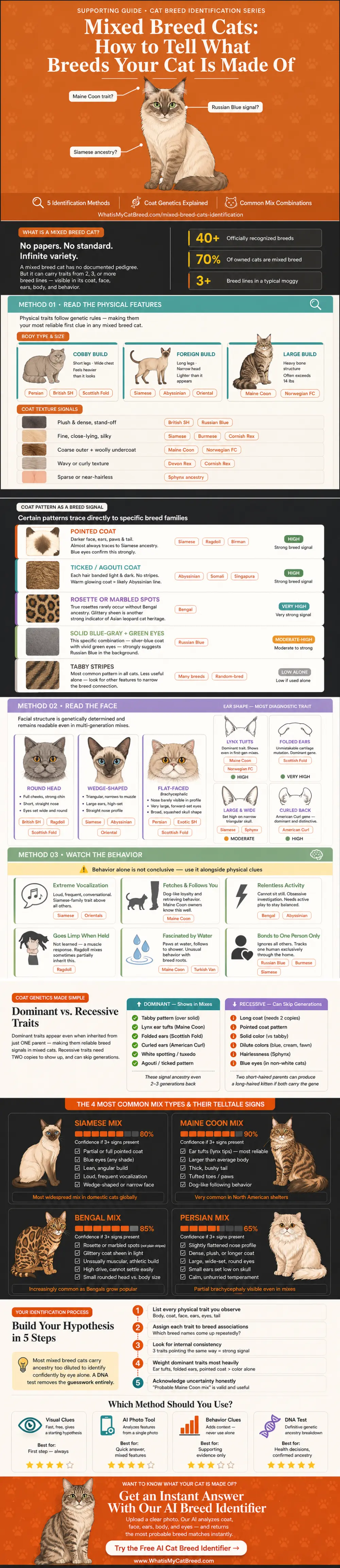
To sum up, we have designed the following infographic which will guide you through identification process of mixed-breed cats in an easy way. Check it out!
Frequently Asked Questions
Can you tell what breed a mixed cat is just by looking at it?
You can form a reasonable hypothesis — sometimes a strong one. Physical traits like ear tufts, folded ears, pointed coat pattern, and body type follow genetic rules and appear reliably even in mixed breed cats. But visual identification cannot confirm breed ancestry with certainty. Two cats can look nearly identical while having very different genetic backgrounds, and one striking trait (like large ears) can appear in many unrelated breeds. Visual analysis gives you a starting point, not a verdict.
What is the most reliable way to identify a mixed breed cat's ancestry?
A feline DNA test is the most scientifically reliable method. It analyzes your cat's genetic markers against a reference database of known breeds and returns percentage estimates of each breed detected. For a faster, cost-free starting point, our Quiz on What Breed is My Cat asks you a few questions related to your cat and based on your answers, gives you probable breed of your cat.
Do mixed breed cats inherit personality from their breed ancestors?
Partially. Breed-typical behavioral tendencies are real and rooted in genetics — Siamese vocalization, Maine Coon sociability, and Bengal energy levels are all genetically influenced traits. But individual personality also varies enormously, and mixed breed cats may inherit competing tendencies from different breed lines that produce something entirely their own.
Why does my cat look like a purebred but have no papers?
Purebred-looking cats without papers are common. A cat can inherit the full visual expression of a breed from a purebred ancestor two or three generations back without any documentation of that ancestry. It can also carry the same genetic variants that define a breed without being that breed — the pointed coat gene, for example, appears in the general cat population independently of the Siamese breed. Looking like a purebred and being a purebred are genuinely different things.
Are mixed breed cats healthier than purebreds?
Generally, yes — and this is well-supported by evidence. Mixed breed cats benefit from hybrid vigor (also called heterosis) — the genetic diversity that comes from combining unrelated lineages. This diversity tends to reduce the expression of recessive genetic diseases, which often require two copies of a faulty gene to manifest. Purebred cats, developed through selective breeding within closed gene pools, face higher rates of breed-specific inherited conditions. This doesn't make purebreds unhealthy — but it is a genuine advantage of mixed breed genetics.
Most cats are mysteries wrapped in fur. That's part of what makes them so compelling. Whether your cat turns out to carry Siamese genes, Maine Coon ancestry, or a completely untraceable mix of random-bred cats going back centuries, the identification process teaches you to look more carefully at the animal in front of you — its structure, its coat, its movement, its behavior. That attention is worth something independent of the answer.