There is a moment every cat owner has — sitting across from their cat, really looking at its face, and thinking: where did you come from?
The answer might actually be written right there. A cat's facial structure is among the most genetically stable features it carries. Skull shape, muzzle length, eye placement, and ear geometry are all controlled by genes that persist stubbornly across generations — which is precisely why a cat with Siamese ancestry three generations back can still show that narrow, angular face even when nothing else gives it away.
Reading facial features is not guesswork. It is pattern recognition built on genetics. Once you know what to look for — and more importantly, how to look — a cat's face becomes one of the most reliable breed identification tools available.
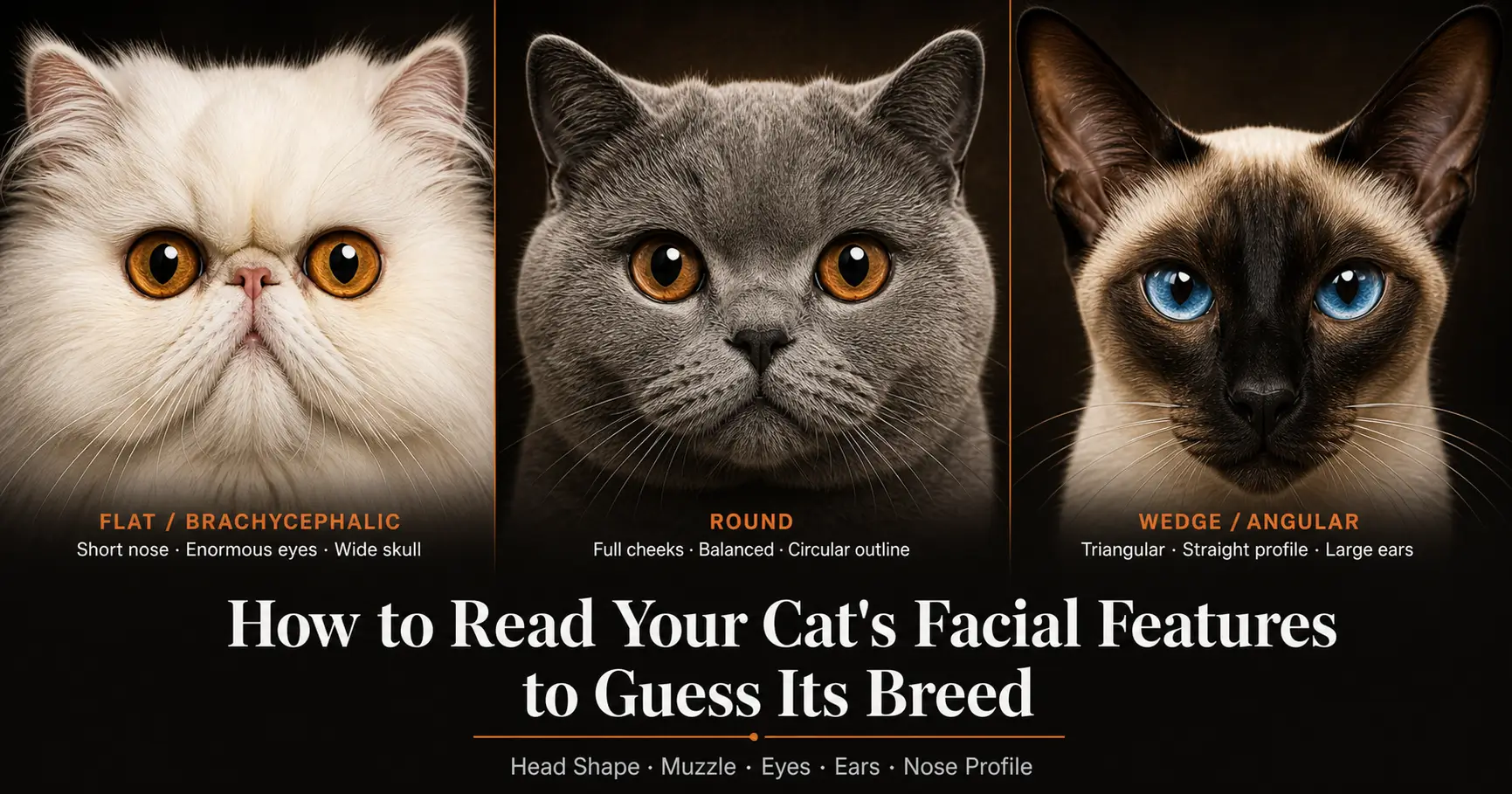
This guide takes you through each facial feature systematically, explains what the genetics produce, and maps the results to specific breed families.
Start Here: How to Actually Look at a Cat's Face
Most people look at cat faces the way they look at people's faces — as a whole impression. That works fine socially. It fails completely for breed identification.
The trick is to deconstruct the face into individual measurements and shapes. Look at one feature at a time. Assess it. Then move to the next. Your brain will want to form an overall impression immediately — resist that. The overall impression is often misleading because a single dominant trait (enormous ears, for instance) can pull the perception of the whole face toward one breed even when other features point elsewhere.
Here is the sequence that works best:
- Head shape — the skull structure underlying everything
- Muzzle and nose — length, width, and profile
- Eye shape, size, and placement
- Ear size, shape, and placement
- Chin and jaw structure
Work through them in that order. By the time you reach the chin, you will have a working hypothesis that the chin either confirms or complicates.
Head Shape: The Foundation of Everything
The skull is the canvas. Everything else — eyes, nose, ears, muzzle — is positioned on top of it. Getting the head shape right first makes every subsequent feature far easier to read.
There are four meaningful head shape categories in domestic cats:
Round
A truly round skull is broad from ear to ear, high from the jaw to the top of the head, and shows gentle, unbroken curves in every direction. There are no angles. No flattening. No elongation. The head looks, from the front, like a perfect circle sitting on top of the neck.
Round-headed cats have full cheeks that create visible width at the midface. The forehead is broad and domed. The chin is strong and well-developed, completing the circular silhouette.
This head shape belongs firmly to the cobby breed family — British Shorthair, Scottish Fold, Ragdoll, and the American Shorthair in its rounder expressions. The British Shorthair is perhaps the purest example: a skull so consistently round that breed judges describe it as having an unbroken circular outline when viewed from the front.
Caption: The British Shorthair's round skull is one of the most distinctive head shapes in domestic cats — visible immediately from a front-facing angle.
Wedge / Triangular
The wedge head is the architectural opposite of the round head. It is defined by straight lines converging from the widest point — the ears — to the narrowest point — the tip of the muzzle. From the front, a true wedge-headed cat looks almost triangular. The sides of the head are flat planes, not curves. The cheekbones are prominent but not wide. There is no roundness anywhere.
The Siamese is the reference breed for this shape, and in its modern extreme form, the wedge is so pronounced that the skull looks almost geometric. The Oriental Shorthair takes it even further. The Cornish Rex and Sphynx also carry wedge or modified-wedge skulls, though with enough individual variation to complicate identification.
A key detail of the wedge head: the nose continues the line of the forehead without any break or stop. This is called a straight profile. Run your finger from the top of the skull down the nose — on a true wedge-headed cat, that line is continuous and uninterrupted.
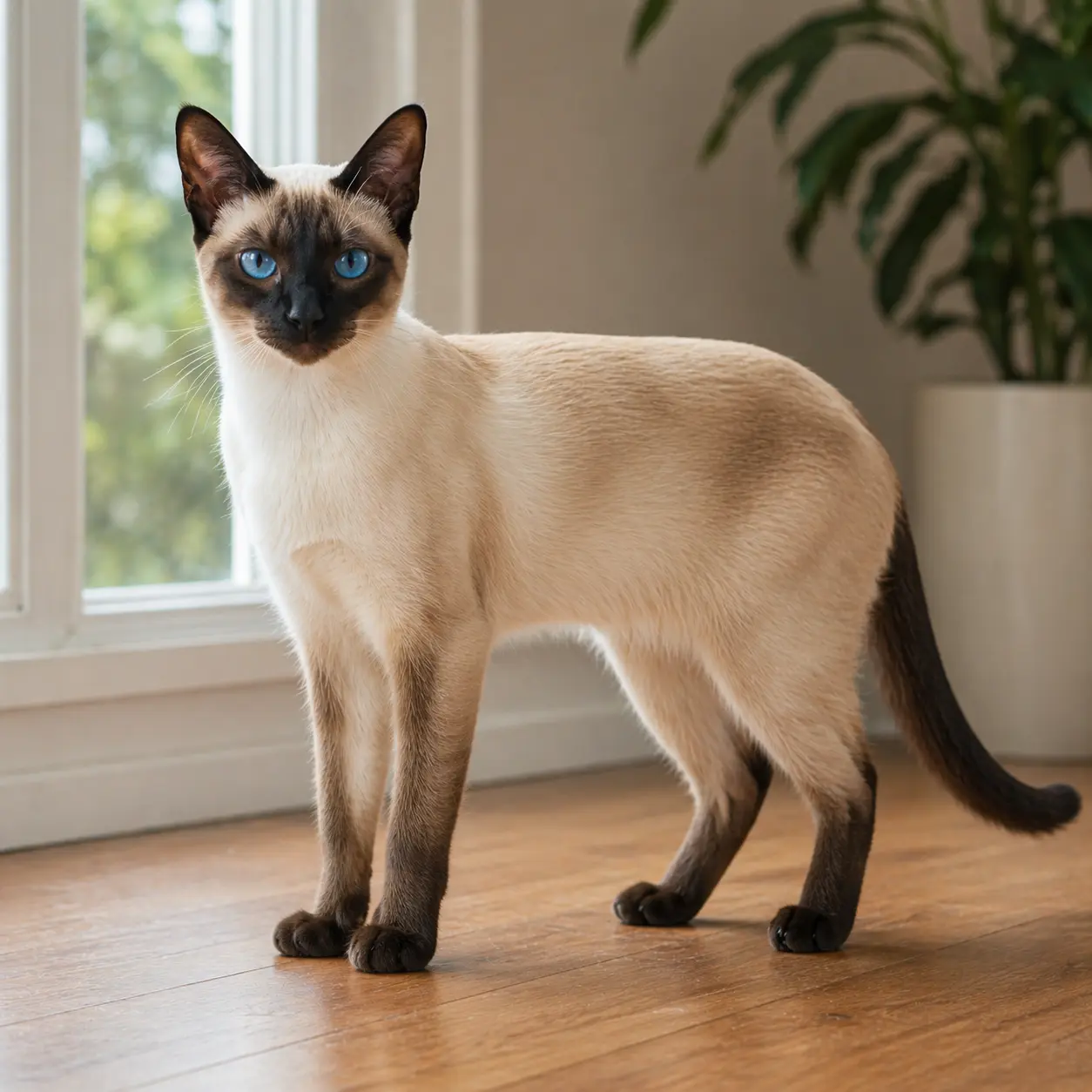 Caption: The Siamese wedge head — straight profile, flat planes, converging lines from wide-set ears to a narrow pointed muzzle.
Flat / Brachycephalic
Brachycephaly refers to a skull that is compressed front-to-back — shortened along the axis running from the nose to the back of the head. The result is a flat face where the nose sits at or near the level of the eyes rather than projecting forward.
This is perhaps the easiest head shape to identify because it looks so dramatically different from a typical cat face. The nose barely protrudes — sometimes it is so compressed it appears concave. The eyes are positioned very forward and appear enormous relative to the face. The skull is wide but the facial depth from the back of the eye to the nose tip is minimal.
The Persian carries this to its most extreme expression. The Exotic Shorthair shares the same skull structure in a shorter-coated version. Even the Scottish Fold frequently shows mild to moderate brachycephaly alongside its folded ears.
One important health note: significant brachycephaly affects breathing, dental structure, and tear duct drainage. Even in mixed-breed cats, partial brachycephaly — a slightly shortened nose, wider-than-average skull — suggests Persian or Exotic Shorthair ancestry and warrants monitoring.
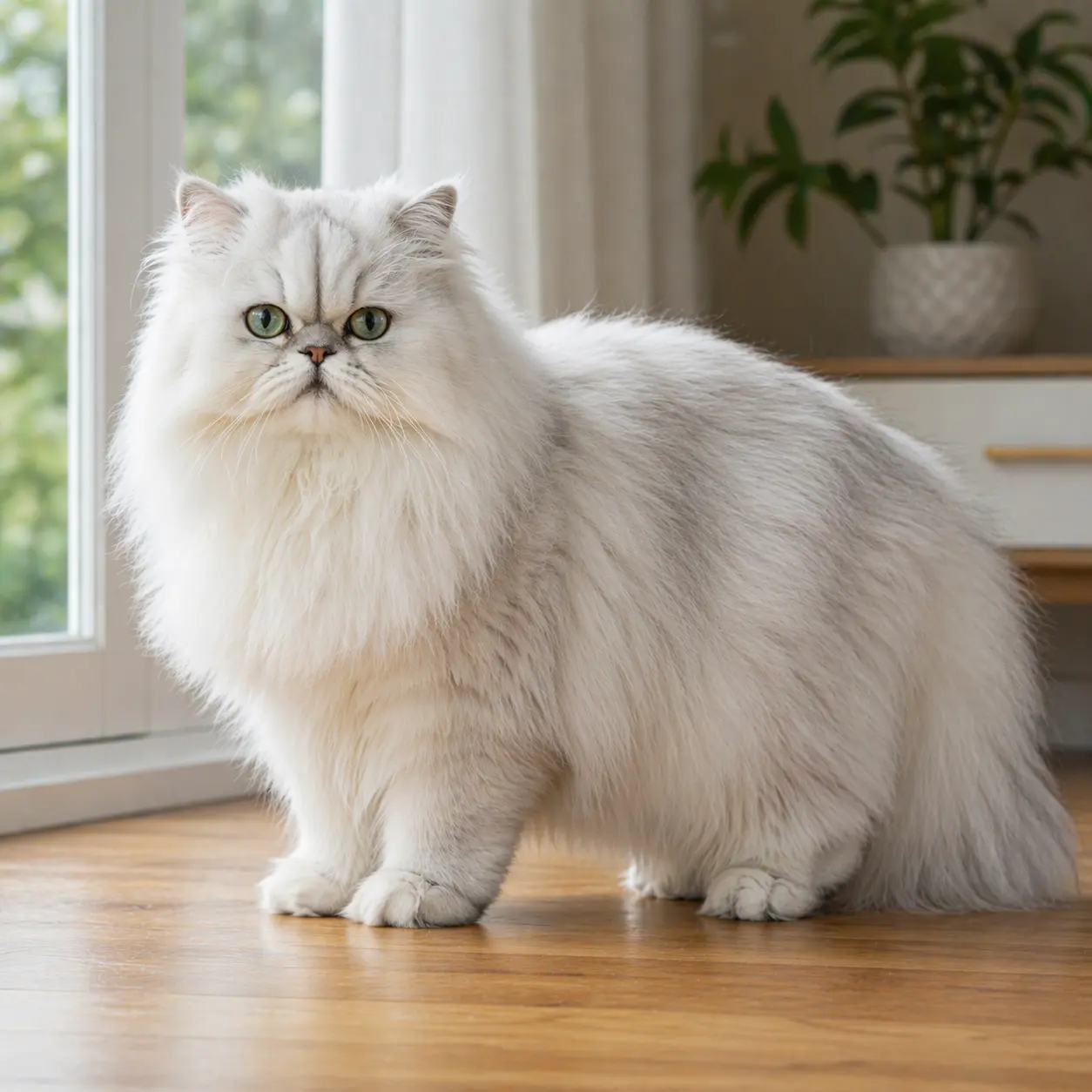 Caption: The Persian's brachycephalic skull is the most extreme flat-face structure in domestic cats — the nose sits almost at eye level.
Intermediate / Modified Wedge
The majority of cats — especially mixed breeds — fall into a middle category that is neither fully round nor wedge-shaped. This intermediate skull is sometimes called a modified wedge or oval head. It is longer than a round skull but not angular. It has some width across the cheekbones but lacks the pronounced triangular geometry of a true wedge.
The Maine Coon has a modified wedge head with a notably square muzzle — wide and blunt rather than pointed. The Norwegian Forest Cat has a triangular head that is flatter than a Siamese wedge and longer than a British Shorthair round. The Ragdoll sits between modified wedge and semi-cobby.
Understanding the modified wedge matters because most mixed-breed cat faces land somewhere in this range. A mixed-breed cat with slight wedge tendencies (flat forehead, somewhat narrow muzzle) may carry Siamese or Abyssinian ancestry. A mixed-breed with a broader, slightly square muzzle on a moderate oval skull may have Maine Coon in the background.
The Muzzle: Length, Width, and Profile
The muzzle is where the most revealing breed details concentrate. Small changes in muzzle length and width produce dramatically different appearances — and these differences track reliably to specific breed families.
Muzzle Length
Short muzzles — where the distance from the eye to the nose tip is minimal — appear in cobby and brachycephalic breeds. The shorter the muzzle, the more the face appears "pushed in." In extreme brachycephalic cats like the Persian, the muzzle has nearly disappeared entirely.
Long muzzles — where the nose extends notably forward from the plane of the eyes — appear in foreign and semi-foreign breeds. The Abyssinian, Siamese, and Norwegian Forest Cat all have muzzles that project clearly from the face.
Medium muzzles — the most common in both pedigree and mixed-breed cats — belong to the moderate head types. The American Shorthair, British Shorthair in its less extreme expressions, and most mixed-breed cats land here.
Muzzle Width and Shape
Muzzle width interacts with length to produce distinct shapes:
Square muzzle — wide and blunt, with a clearly defined "box" shape when viewed from the front. This is a Maine Coon signature. Breed judges specifically look for visible width and squareness in the Maine Coon muzzle — it is one of the breed's defining facial characteristics, easily visible in Maine Coon mixes even when other breed features are diluted.
Tapered muzzle — narrows progressively from cheekbones to nose tip, producing the pointed or sharp appearance of Siamese-family cats. The narrowing is smooth and continuous in a true foreign-type muzzle.
Pinched muzzle — very narrow and compressed, appearing almost as a small protrusion on the flat face. Persian and Exotic Shorthair territory. Anatomically different from a tapered muzzle — the narrowing here is due to skull compression rather than a naturally tapering jaw.
The Nose Stop
The nose stop is the angle or break between the forehead and the nose. It is one of the most diagnostically useful single features on a cat's face.
No stop — continuous straight line: Siamese, Oriental, Abyssinian, and their relatives. The forehead flows into the nose without any angle change.
Slight stop: Maine Coon, Norwegian Forest Cat, most moderate head types. A very subtle concave angle between the forehead and nose — present but not pronounced.
Pronounced stop: British Shorthair, Ragdoll, American Shorthair. A clear angular transition between the forehead and the nose bridge.
Deep stop / nose above eye level: Persian, Exotic Shorthair. So pronounced that the nose actually sits at or slightly above eye level when viewed in profile.
| Nose Profile | Stop Description | Associated Breeds | How Easy to Spot |
|---|---|---|---|
| Straight / no stop | Forehead and nose form one continuous line | Siamese, Oriental SH, Abyssinian, Cornish Rex | Very easy — the straight line stands out |
| Slight stop | Gentle concave angle — subtle | Maine Coon, Norwegian FC, Ragdoll | Easier in side profile than front view |
| Moderate stop | Clear angular break between forehead and nose | British SH, American SH, Russian Blue | Clearly visible in profile |
| Deep stop / break | Nose sits at or near eye level | Persian, Exotic SH, some Scottish Folds | Unmistakable — immediately obvious |
Eyes: Shape, Size, Set, and Color
A cat's eyes communicate breed information through four separate variables: shape, size, set (position on the skull), and color. Each needs to be assessed independently.
Eye Shape
Round eyes — a circle, or very close to it — belong primarily to the cobby breeds. British Shorthair, Persian, Scottish Fold. The roundness is not incidental; it is a function of the broad, round skull creating space for large, circular eye openings.
Almond eyes — an oval with slight tapering at the inner and outer corners — are the most neutral eye shape and appear across many breeds including the Ragdoll, Maine Coon, and Norwegian Forest Cat. This shape does not give strong breed signal on its own but helps confirm or question other features.
Oblique almond eyes — almond-shaped but set at an angle, tilting upward toward the outer corner — are a foreign-type signal. Siamese, Abyssinian, Egyptian Mau. When viewed from the front, the inner corner sits lower than the outer corner, giving the eye a slanted appearance. This is a genetic feature, not a photographic trick.
Lemon-shaped eyes — wide at the outer corner, narrowing dramatically at both ends — belong almost exclusively to the Sphynx. This distinctive eye shape is among the most recognizable single eye features in any breed.
Caption: Left to right: the round eyes of a British Shorthair, the oblique almond set of a Siamese, and the distinctive lemon shape of a Sphynx — three genetically distinct eye structures.
Eye Size
Eye size relative to the face is a meaningful signal. Large eyes relative to facial size appear in brachycephalic breeds (Persian, Exotic Shorthair) and in round-headed breeds (British Shorthair). The eyes appear large partly because they genuinely are, and partly because the compressed skull brings them forward and closer to the surface.
Proportionally moderate eyes — present in most foreign and semi-foreign breeds — appear smaller than Persian eyes even when their actual size is comparable, simply because the longer muzzle and wider skull provide more visual context.
Eye Color and Breed Association
Eye color alone is insufficient for breed identification. Almost any color can appear in almost any mixed-breed cat. But certain color-feature combinations carry genuine breed signals:
- Vivid blue eyes in a non-white cat almost always trace to the pointed coat gene — linking the cat firmly to the Siamese family (Siamese, Ragdoll, Birman, Balinese)
- Vivid green eyes on a solid blue-gray coat — strongly suggests Russian Blue ancestry
- Deep copper or orange eyes on a plush cobby cat — British Shorthair or Persian territory
- Aqua or turquoise eyes — a Tonkinese trait, produced by a specific combination of the pointed and sepia genes
- Odd eyes (one blue, one gold or green) — appears most in Turkish Angora and white cats of various breeds
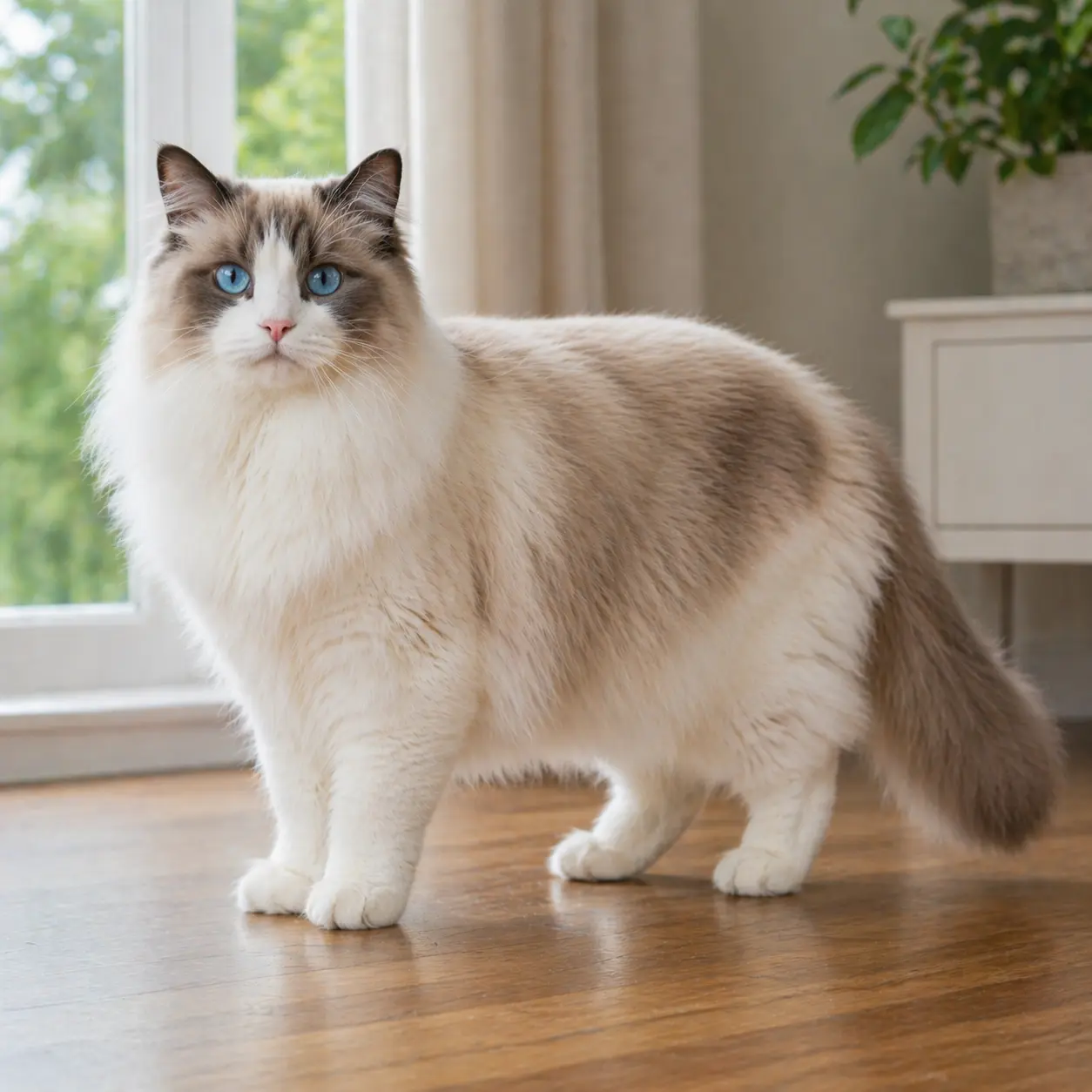 Caption: The Ragdoll's deep blue eyes appear in all coat varieties of the breed — blue eyes on a non-white pointed cat almost always trace to Siamese-family genetics.
Ears: The Most Genetically Specific Feature
If you could only use one facial feature for breed identification, ears would be the strongest choice — not because they always signal a breed, but because certain ear traits are controlled by very specific dominant genes that appear reliably even in multi-generation mixed cats.
Ear Size
Large ears relative to head size — where the ear base is wide and the ear height is significant — belong to foreign and semi-foreign breeds. Siamese, Oriental Shorthair, Abyssinian, Sphynx. In extreme cases (some Oriental lines and Sphynx), the ears are so large relative to the skull that they appear almost comically disproportionate — but this is genetically accurate.
Small to medium ears with a closed base and rounded tips belong to cobby breeds. British Shorthair ears sit low and wide on the round skull with noticeably rounded tips. Persian ears are even smaller, set further apart, and contribute to the breed's distinctive silhouette.
Ear Placement
Where on the skull the ears sit tells you almost as much as their size.
Ears set high and wide on a triangular skull with angled base — Siamese-family orientation. The ear base forms an extension of the skull's triangular outline rather than sitting on top of it.
Ears set wide apart but lower on a round skull — British Shorthair and Persian placement. The ears contribute to the rounded overall silhouette rather than breaking it.
Ears set at a moderate height with slight outward tilt — Maine Coon and Norwegian Forest Cat. Large but not extreme, positioned to complete a rectangular or triangular head outline.
Genetically Specific Ear Mutations
Two ear traits in cats are controlled by dominant single-gene mutations — making them among the most reliable breed signals available:
Folded ears (Scottish Fold): The cartilage mutation that causes the characteristic forward-and-downward fold is dominant. One copy of the gene produces folded ears; two copies produces severe joint disease. In mixed-breed cats, any degree of forward ear fold — even partial, even subtle — almost certainly indicates Scottish Fold ancestry. This trait does not arise spontaneously.
Curled ears (American Curl): The curl mutation causes the ear cartilage to curl backward, away from the face. Like the fold, this is a dominant gene. Curled ears in a mixed-breed cat indicate American Curl ancestry. The curl typically becomes apparent in the first few weeks of life and increases until the cat reaches adulthood.
Tufted ears (lynx tips): Prominent hair tufts occur in breeds such as Maine Coons and Norwegian Forest Cats, but they also occur in cats without documented pedigree ancestry. Treat them as one visible clue to compare with coat, head, and body traits—not proof of a particular mix.
| Ear Trait | Genetic Basis | Breeds | Signal Strength in Mixes |
|---|---|---|---|
| Folded forward | Dominant single gene (Fd) | Scottish Fold, Scottish Straight | Very high — dominant, appears in first-gen mixes |
| Curled backward | Dominant single gene (Cu) | American Curl | Very high — dominant, visible from kittenhood |
| Lynx tufts at tip | Polygenic — multiple genes | Maine Coon, Norwegian FC | High — persists across several generations |
| Very large, wide-based | Polygenic skull genetics | Siamese, Sphynx, Oriental SH | Moderate — may dilute in mixed cats |
| Small, rounded tip | Cobby skull genetics | British SH, Persian | Moderate — reads most clearly alongside round skull |
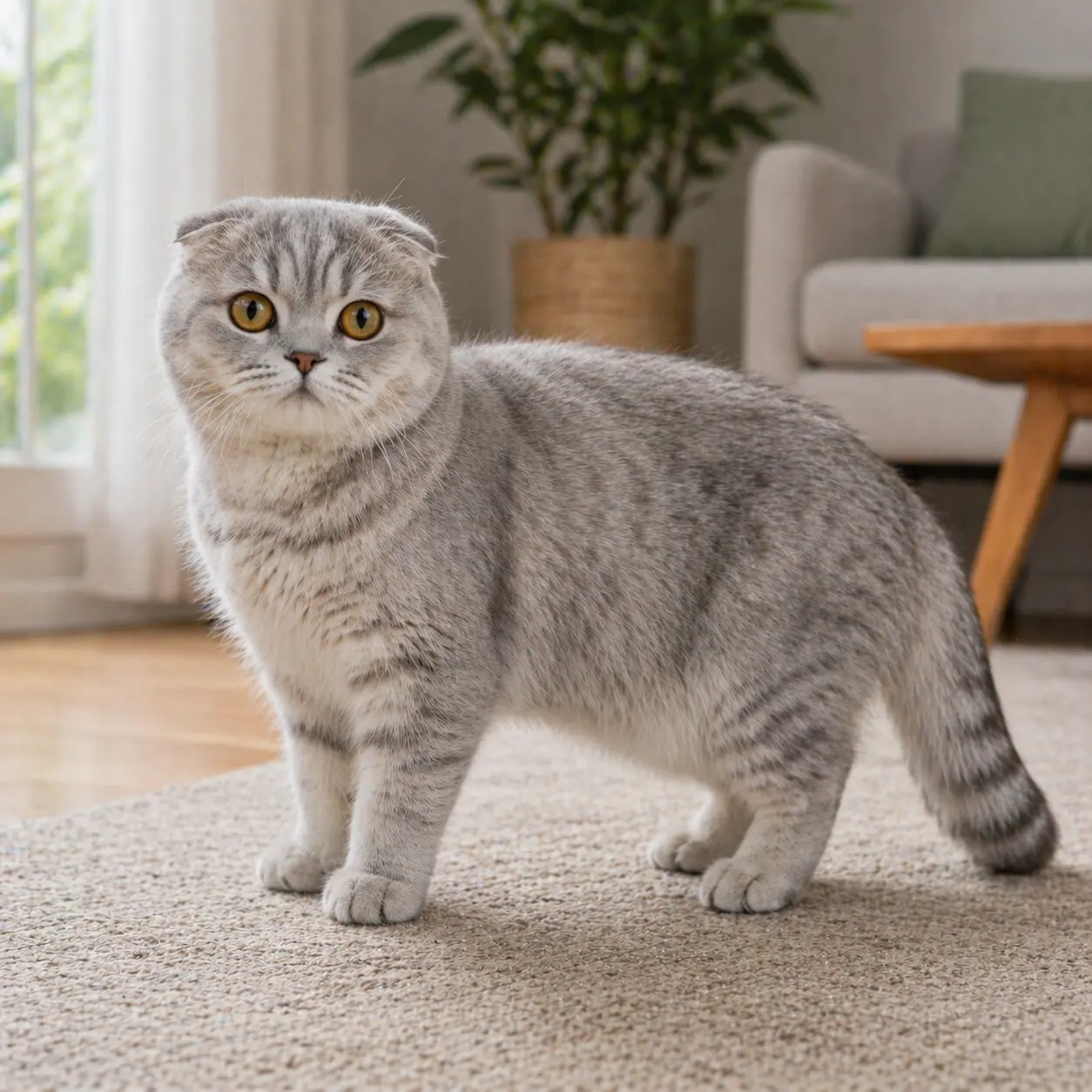 Caption: The Scottish Fold's ear fold is caused by a dominant cartilage gene — even partial folding in a mixed-breed cat is a near-certain indicator of Scottish Fold ancestry.
Chin and Jaw Structure
The chin is the least discussed and most underappreciated facial feature in breed identification. It deserves more attention than it typically gets.
A strong, well-developed chin that forms a clear vertical line below the lips — when viewed in profile — is a feature of foreign-type cats. The Siamese chin sits directly below the nose, forming a clean straight line from nose tip to chin. This structural clarity is part of what gives foreign-type cats their sharp, angular appearance in profile.
A rounded chin that curves gently and recedes slightly belongs to cobby breeds. The British Shorthair has a notable chin — present but softly rounded, contributing to the overall circular profile.
A receding or minimal chin in a cat with an otherwise angular face can signal Sphynx or Devon Rex influence — both breeds where the chin does not project strongly, giving the face an almost elfin quality.
Jaw width is also informative. A wide jaw in a moderate-framed cat suggests British Shorthair or American Shorthair ancestry. A narrow jaw in an otherwise medium-sized cat can hint at foreign-type genetics even when other features are less obvious.
Putting the Face Together: A Practical Approach
Once you have assessed each feature individually, the synthesis is straightforward. You are looking for convergence — multiple features pointing to the same breed family — rather than a single definitive marker.
A useful way to think about it: each facial feature casts a vote. Round skull votes cobby. Straight nose profile votes foreign. Lynx-tipped tufted ears vote Maine Coon. When three or four features vote the same way, the case is strong. When features divide their votes, the cat is likely a mix carrying genetics from more than one breed family — and that division is itself useful information.
The face works best as one layer of a complete physical assessment. This breakdown of physical identification covers body type, coat, and ears alongside facial features as part of a unified system — which gives a more complete picture than face-reading alone.
For mixed-breed cats specifically — where the facial features often show a blend rather than a clear type — our guide to reading mixed breed physical signals walks through how to interpret partial expressions of breed traits.
Facial Features Across the Most Common Breeds
| Breed | Head Shape | Muzzle | Nose Profile | Eyes | Ears |
|---|---|---|---|---|---|
| Siamese | Wedge / triangular | Long, tapered | Straight — no stop | Almond, oblique, blue | Large, wide-based, high-set |
| Persian | Round, brachycephalic | Very short, pinched | Deep break — nose near eye level | Round, very large, copper | Small, rounded, wide-set low |
| British Shorthair | Round, broad | Medium, wide | Moderate stop | Round, large, copper/gold | Medium, rounded tips, wide-set |
| Maine Coon | Modified wedge, square muzzle | Long, noticeably square | Slight concave curve | Oval to slightly oblique | Large, tufted lynx tips, tall |
| Abyssinian | Modified wedge | Medium, tapered | Gentle — slight stop | Large, almond, amber/green | Large, alert, wide-set |
| Ragdoll | Broad modified wedge | Medium, rounded | Gentle stop | Oval, large, vivid blue | Medium-large, wide-set |
| Scottish Fold | Round to semi-round | Short to medium | Moderate stop | Round, large, wide-set | Folded forward — dominant gene |
| Sphynx | Modified wedge | Medium | Slight to moderate | Lemon-shaped, deep-set | Very large, wide, upright |
| Bengal | Broad, rounded contours | Wide, full, rounded | Slight stop | Oval, large, green/gold | Medium, rounded tip, forward-set |
| Russian Blue | Wedge, flat forehead | Medium | Moderate stop | Almond, vivid green | Large, pointed, wide at base |
When Facial Features Give Mixed Signals
Mixed-breed cats frequently present contradictory facial features. This is not a problem — it is accurate information.
A cat with a round skull but oblique almond eyes is telling you that it inherited cobby skull genetics from one side of the family and foreign-type eye genetics from the other. A cat with a straight nose profile but small, rounded ears inherited a Siamese-family nose on a British-family ear set. These combinations are common and meaningful.
When features conflict, prioritize the genetically dominant and specific traits over the general ones. Folded ears, curled ears, lynx tufts, and brachycephalic flattening are all either dominant single-gene traits or heavily selected-for polygenic traits — they carry stronger identification weight than eye color or general skull roundness, which can arise from multiple genetic backgrounds.
If you prefer a guided approach to this — where the questions do the work of separating features one by one — the breed quiz walks through facial features as structured questions and returns a breed result based on the combination of your answers.
Understanding how facial structure fits alongside body conformation and coat pattern gives you the most complete identification picture available without a DNA test. The face alone is powerful. Combined with the rest of the physical assessment, it becomes genuinely reliable.
Cornell University's College of Veterinary Medicine maintains detailed breed health profiles that cover breed-specific facial anatomy — particularly useful for understanding how brachycephalic facial structure affects health in cats with Persian or Scottish Fold ancestry.
We have prepared a visual infographic that maps all the major facial features — head shape, nose profile, eye shape, ear type, and chin structure — onto their associated breed families. It presents everything covered in this article in a single reference image you can save and return to whenever you need it.
Frequently Asked Questions
What part of a cat's face is most useful for identifying its breed?
Ear traits are the single most genetically specific facial feature. Folded ears, curled ears, and lynx tufts are all controlled by dominant or highly penetrant genes that appear reliably even in cats several generations removed from a purebred ancestor. Head shape runs a close second — the difference between a round, wedge, and flat skull is visible immediately and maps directly to breed families. If you can only assess two features, start with ears and then skull shape.
My cat has a flat face but is not a Persian — what else could it be?
Several breeds share the brachycephalic facial structure to varying degrees. The Exotic Shorthair is essentially a shorthaired Persian with identical skull structure. The Scottish Fold frequently shows mild to moderate facial flattening alongside its ear fold. Himalayan cats (a Persian-Siamese cross) also display brachycephalic features. In mixed-breed cats, partial flattening — a slightly shortened muzzle, wider-than-average skull — often traces to Persian or Exotic Shorthair ancestry even when the effect is much less extreme than a purebred would show.
Can eye color alone tell me what breed my cat is?
Rarely. Eye color has some breed associations — vivid green with a solid blue-gray coat points strongly toward Russian Blue, and blue eyes in a non-white cat are closely linked to the pointed coat gene and Siamese ancestry. But for most cats, eye color alone is not diagnostic. The same eye color appears across dozens of breeds and in the random-bred domestic cat population. Eye color works best as a confirming detail alongside other features, not as a standalone identifier.
Why does my cat's face look like a specific breed even though it came from a shelter?
Because looking like a breed and being that breed are two different things. A cat can inherit the complete visual expression of a specific breed — head shape, eye set, ear structure, coat — from ancestors who were not registered purebreds. It can also carry the same underlying genes that the breed was developed to express, independently of any formal breeding program. Shelter cats are not random assemblies of unrelated traits — they carry genuine genetic lineages. Their faces reflect those lineages even without a pedigree document.
Does a cat's face change as it ages?
Yes, in some ways. Kittens have proportionally larger eyes and ears relative to their skull, which can make breed features harder to assess accurately. Adult facial structure settles between 12 and 18 months in most breeds — and somewhat later in large-framed breeds like the Maine Coon, which can continue filling out until age three or four. Brachycephalic features generally become clearer with age as the skull reaches its full shape. For the most accurate visual breed assessment, wait until the cat has reached at least 12 months of age. For a detailed guide on what physical features reveal at different life stages, read more here.